
Breaking the Elder Board Glass Ceiling
There's a church in our area that I deeply respect. They're doing incredible Kingdom work, reaching thousands of people, and genuinely seeking to honor God in all they do. They've even broken through many traditional barriers by allowing women to serve as pastors and leaders at almost every level.
Almost.
There's one final ceiling they haven't broken: the elder board. At the highest level of church governance, only men are allowed. And they base this restriction on 1 Timothy 3—the same passage we've been examining.
This church's approach represents where many well-meaning congregations have landed. They want to empower women, they sense God's heart for equality, but they feel bound by what they believe Scripture "clearly teaches." So they create a compromise: women can lead everywhere except the very top.
But here's what I've discovered: compromise with hierarchy is like taking antibiotics for five days instead of ten. The infection doesn't just remain—it comes back stronger than ever.
The Leaven Problem
Jesus warned us about the leaven of the Pharisees—how a little bit of corrupted teaching spreads through the whole batch of dough. The same principle applies to hierarchical thinking in the church.
As long as there's one level where maleness is considered a qualification for leadership—even just one—the underlying assumption of male supremacy remains embedded in the system. It will inevitably work its way through every other level of the organization, no matter how well-intentioned the leaders might be.
Think about it: if the ultimate governing authority of the church is reserved for men only, what message does that send about women's capacity for spiritual discernment? About their ability to hear from God? About their fitness for the most important decisions?
The message is subtle but clear: women are suitable for secondary roles, but when it really matters—when the big decisions need to be made—we need men in charge.
The Missing Half of God's Image
But there's an even deeper problem than organizational dynamics. When we exclude women from our highest leadership circles, we're not just limiting women—we're limiting God Himself.
If God created both male and female in His image, and if that image requires both masculine and feminine perspectives to be complete, then what happens when we systematically exclude the feminine voice from our most important conversations?
We're missing a dimension of Holy Spirit that could be moving in those elder meetings. We're operating with only half of God's perspective represented. We're making decisions about God's people without access to the full range of wisdom that God has provided.
It's like trying to drive a car with half the engine broken. The vehicle doesn't just operate at half capacity—it doesn't work properly at all.
Why the Church Seems Powerless
This might explain one of the most perplexing questions facing the modern church: Why do we seem so weak and powerless when we serve such an awesome God?
When I read the New Testament, I see a small group of believers literally changing the world. They didn't just perform miracles—they transformed entire cultures. They took the gospel from a small Jewish sect to a movement that would reshape human history.
And here's what's remarkable: they did this while fully including women in leadership roles. Despite living in a culture where women couldn't read, weren't allowed to learn Scripture, and had no legal standing, the early church deliberately included women as apostles, deacons, teachers, and church planters.
Junia was an apostle. Phoebe was a deacon and leader. Priscilla was a teacher. Lydia likely pastored the house church in Philippi. These weren't exceptions to the rule—they were part of the engine that powered the early church's world-changing impact.
Could it be that our systematic exclusion of women from full leadership participation has broken the very engine Jesus designed to transform the world?
The "Someone Has to Lead" Fallacy
"But someone has to be in charge!" people often protest. "Doesn't every organization need clear authority structures?"
This objection reveals how deeply we've been influenced by worldly power structures. We struggle to imagine decision-making outside a hierarchy where someone must have "final authority."
But what if that's not God's design at all?
Look at how the Trinity functions: Father, Son, and Holy Spirit operate in perfect unity without a chain of command. There's no "final authority" needed to break ties because there are no ties to break. They submit to one another in a beautiful dance of mutual honor and deference.
The healthiest families I know don't operate with rigid hierarchies where one person always has the final say. Instead, leadership flows naturally based on who has relevant expertise, who has more capacity in different seasons, and whose gifts are most needed for particular challenges.
The same principle applies to church leadership. Instead of asking "Who's in charge?" we should be asking "How can we seek God's wisdom together? How can we honor each person's gifts and perspective? How can we make decisions that reflect the full counsel of God?"
The Practical Difference
Let me paint you two pictures:
Picture 1: The Traditional Elder Board
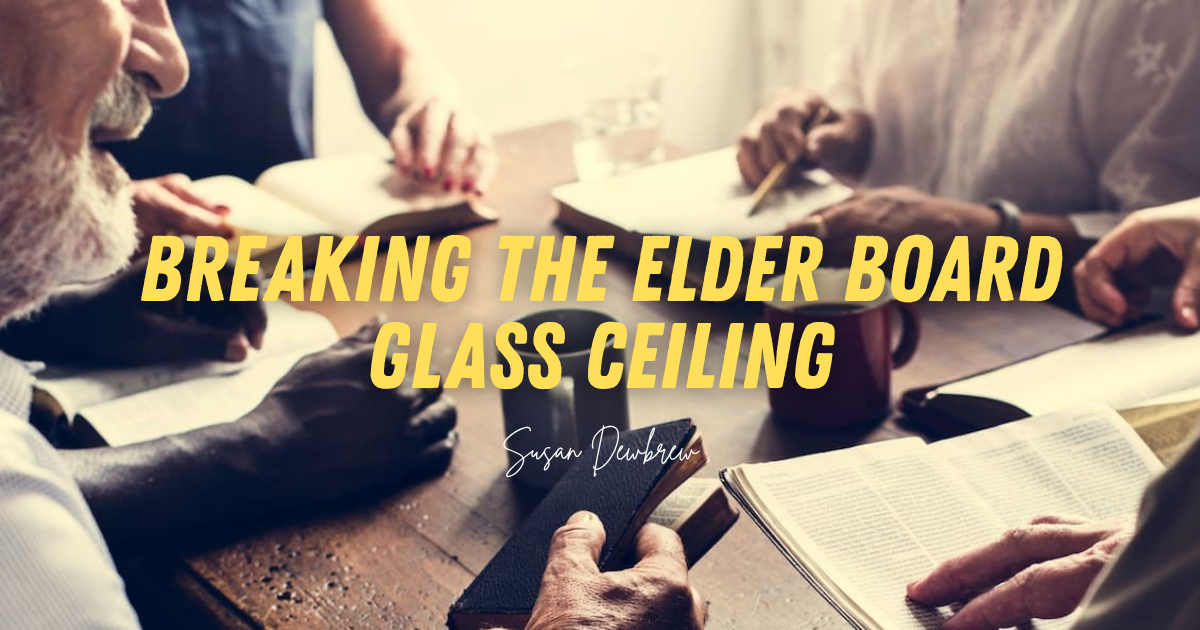
A group of well-meaning men sits around a table discussing whether to launch a new women's ministry. They pray, they discuss, they make the best decision they can with the information they have. But something's missing—the very perspective that could provide the deepest insight into what women in their congregation actually need.
Picture 2: The Inclusive Elder Board
Men and women sit around the same table discussing the same ministry opportunity. The conversation is richer, the insights deeper, the decision more informed. When they pray together, they're accessing the full range of spiritual gifts God has distributed among His people.
Which scenario is more likely to produce decisions that truly reflect God's heart for His people?
Breaking Free from Compromise
If you're in a church that genuinely wants to honor women but feels restricted by 1 Timothy 3, I want to encourage you: the restriction isn't in Scripture—it's in the translation.
As I've shown in previous posts, the original Greek text contains no masculine pronouns in Paul's qualifications for church leadership. The translators added those pronouns based on their own cultural assumptions about gender roles.
When you read what Paul actually wrote—"if anyone aspires to the office of overseer"—the pathway to full inclusion becomes clear. Paul wasn't limiting women from church leadership any more than he was limiting them from any other aspect of ministry.
The Courage to Go All the Way
Breaking through the elder board glass ceiling requires courage. It means being willing to question long-held interpretations, even when they're deeply embedded in your tradition. It means being willing to examine whether your church's highest leadership truly reflects the full image of God.
But here's what I've learned: when churches have the courage to fully embrace women in leadership, they don't become weaker—they become stronger. They don't lose their biblical foundation—they discover it more fully.
They don't compromise the gospel—they unleash its full transformative power.
A Vision of What's Possible
Imagine a church where the elder board includes both men and women, each contributing their unique gifts and perspectives. Imagine decisions being made with the full counsel of God represented around the table. Imagine young girls growing up knowing they can aspire to any level of leadership God calls them to.
Imagine the church operating with its full engine restored, powered by both masculine and feminine expressions of God's image working in harmony.
This isn't just a nice ideal—it's a biblical imperative. It's what the early church practiced. It's what Jesus modeled when He included women among His closest disciples and entrusted them with the most important news in human history.
The only question remaining is: Do we have the courage to follow their example?
Blessings,
Susan 😊