
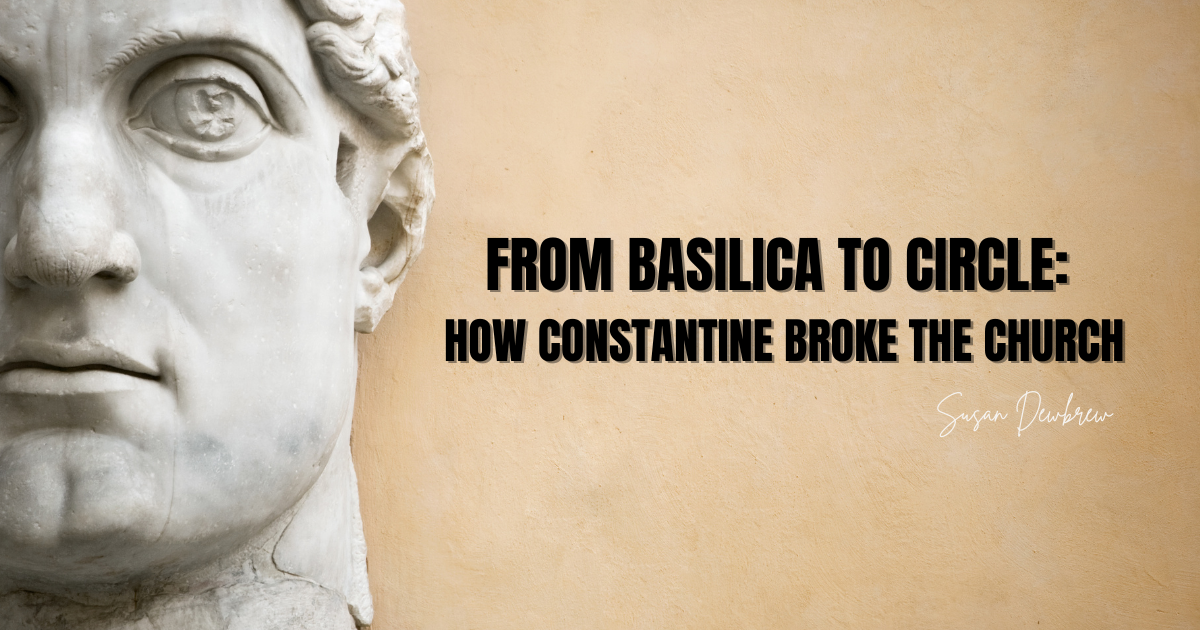
From Basilica to Circle: How Constantine Broke the Church
There was a moment in history when the Church shifted from being a dynamic, world-transforming movement to becoming a religious institution. And in that shift, we lost something precious—something we're only now beginning to recover.
Let me tell you about the day Constantine changed everything.
The Original Configuration
In the early Church, when believers gathered, they typically sat in circles. Partly this was practical—they met in homes, and you can't fit rows of chairs theater-style in someone's living room. But it was also deeply theological.
The circle represented the divine council. Everyone could see everyone else. There wasn't a raised platform where professionals performed while others watched. There were leaders, absolutely—apostles, prophets, elders who had authority and wisdom. But their role was to serve, to equip, to wash the feet of those in the circle.
Even when they gathered in larger settings, like Solomon's Porch, there was still a council dynamic. Different people could stand and speak. It wasn't one person in charge, controlling everything. Look at Acts 15, where they gathered to decide what to do about Gentile believers. It was a council making decisions together, with various voices contributing wisdom.
This is what Jesus meant when He split the veil in the temple. That veil separated the people from the Holy of Holies, where only the high priest could enter once a year. But when Jesus died, the veil was torn from top to bottom (Matthew 27:51, NKJV)—God ripped it open, declaring that everyone could now come into the holy place. We're all kings and priests (Revelation 1:6, NKJV).
No more spectators standing outside watching ministry happen. Everyone gets to come all the way in.
Enter Constantine
Then came Constantine in the 4th century. When he institutionalized Christianity and made it the religion of the Roman Empire, he didn't just give Christians freedom from persecution. He reconfigured how they gathered.
Constantine changed the Christian assembly from circles to basilicas—the model we still use today in most churches. And where did this basilica model come from? It was modeled after his throne room. After his political, institutional, Gentile power structure.
Suddenly, you had rows of people (standing in those days—they didn't even have pews yet) facing a raised platform called the altar, where ministry happened. The people watched. The priests performed.
This was the temple model all over again—the very model Jesus had torn the veil to abolish.
The Pyramid We Can't Escape
The basilica became a pyramid. At the top, you had the clergy—the professionals who had access to God, who could perform the sacraments, who held the authority. At the bottom, you had the laity—the regular people whose job was to show up, listen, financially support the system, and try not to cause trouble.
This division between clergy and laity became so entrenched that we can barely imagine church any other way. Even in Protestant churches that rejected many Catholic structures, we kept the fundamental configuration: professional ministers on a platform, regular Christians in rows, watching.
And this feeds right into our fallen human nature, doesn't it? We want to be somebody. We want to be one of the ones on the platform. We want to get close to power. So we try to climb the pyramid, volunteering for this committee, serving in that capacity, hoping maybe one day we'll be invited into leadership.
But Jesus said, "It shall not be so among you" (Matthew 20:26, NKJV). He said the greatest among us would be the servant of all. He washed feet—the job of the lowest servant—and told us to do likewise.
What We Lost
When we shifted from circle to basilica, from council to theater, we lost something critical:
We lost the priesthood of all believers. Instead of everyone exercising their spiritual gifts, we have professionals doing ministry while everyone else pays to watch.
We lost the expectation that everyone has a contribution. Paul said, "Whenever you come together, each of you has a psalm, has a teaching, has a tongue, has a revelation, has an interpretation. Let all things be done for edification" (1 Corinthians 14:26, NKJV). When's the last time your church gathering looked like that?
We lost the multiplication of ekklesia. Instead of equipping every believer to go plant ekklesia in their workplace, home, and community, we trained people to invite others to church so the preacher could save them during the altar call.
We lost the keys of the Kingdom. Jesus said He would give us keys to bind and loose (Matthew 16:19). But in the basilica model, only the clergy hold keys. Regular Christians get helpful hints on how to have a slightly better marriage or be marginally nicer people, but they don't get their actual keys of dominion.
The "Three Steps to _____ in Jesus' Name" Syndrome
You know what I'm talking about. You go to church, the worship team performs (often quite beautifully), the preacher delivers a message with three alliterated points, maybe tells some stories, applies it to your life with practical tips, says a prayer, and you go home feeling slightly inspired.
By Monday, you have a better attitude. By Tuesday, you're back to walking in the same jealousy, fear, and anxiety you had before. By Wednesday, you've forgotten what the sermon was even about.
This isn't because preachers are bad or the sermons are wrong. It's because the entire structure is designed to make you a consumer of religious content rather than a releaser of God's Kingdom.
You're not being equipped. You're being entertained. You're not being empowered. You're being placated.
The basilica model has become a placebo—giving you just enough spiritual experience to numb your longing for the real thing without actually empowering you to transform the world.
What Gatherings Are Actually For
When I discovered what the ekklesia gathering was originally meant to do, it revolutionized everything.
Ephesians 4:11-12 says Jesus gave apostles, prophets, evangelists, shepherds (pastors), and teachers "for the equipping of the saints for the work of ministry, for the edifying of the body of Christ" (NKJV).
Read that again. The five-fold ministry isn't meant to DO all the ministry while saints watch. They're meant to EQUIP the saints for their work of ministry.
The gathering is a training ground. A place where apostles release apostolic wisdom, prophets release prophetic revelation, evangelists release evangelistic passion, shepherds release pastoral care, and teachers release understanding. We come together to be filled up, equipped, empowered, and then sent out.
Sent out to what? To plant ekklesia everywhere we go.
The goal isn't to get everyone to come to the Sunday gathering. The goal is to equip everyone in the Sunday gathering to go plant ekklesia in their sphere of influence.
What It Looks Like in Practice
At Dewbrew Realty, we've embraced this. We gather regularly for what we call Thirsty Thursdays. We start with worship—that's priestly function, bringing the presence of God. We minister to one another prophetically—encouraging, speaking life, sharing what Holy Spirit is revealing. Then we do business, make decisions together—that's kingly function, governing our sphere of influence according to Kingdom principles.
When we do this, Dewbrew Realty becomes an ekklesia in the earth. Not a religious institution, but a living expression of God's Kingdom doing Kingdom business.
This is what every workplace could be. Every home. Every gathering of believers, no matter how small.
Returning to the Circle
I'm not saying we should abandon large gatherings or never have church buildings. I'm saying we need to recover the circle within whatever structure we use.
We need to return to a model where:
Every believer knows they're meant to minister, not just receive ministry
Leaders see their role as equipping, not performing
The goal is multiplication of ekklesia, not accumulation of attendees
Authority is measured by service, not by position
Everyone is expected to carry the Kingdom into their sphere of influence
This means the stay-at-home mom understands her household is an ekklesia. The business owner sees their company as a place to plant ekklesia. The employee recognizes they can form ekklesia with even one other believer in their workplace.
It means we stop outsourcing our ministry responsibility by dropping a tithe in the offering plate and letting professionals do the work. We stop measuring spiritual maturity by how many church services we attend or committees we serve on.
Instead, we measure it by how effectively we're planting ekklesia, releasing God's Kingdom, transforming the environments we're placed in.
The Leadership Question
I know what you're thinking: "But don't we need leadership? Won't it become chaos without someone in charge?"
Of course we need leadership! But leadership in God's Kingdom doesn't look like the pyramid. It looks like Jesus washing feet.
Leadership in the circle means:
Serving those you lead rather than being served by them
Equipping others to do ministry rather than doing all the ministry yourself
Releasing people into their callings rather than building your empire
Celebrating when people leave to plant ekklesia elsewhere rather than trying to keep everyone under your authority
Yes, there are apostles, prophets, elders—people with recognized authority and wisdom. But their authority comes from their service, their character, their fruit. And their goal is always to work themselves out of a job by raising up others who can lead.
An Invitation to Return
The shift from circle to basilica happened gradually over centuries. The return won't happen overnight either. But it's beginning.
All over the world, believers are waking up to the reality that church isn't a place you go—it's who you are. That gathering on Sunday isn't the main event—it's the equipping center for the main event, which is your life Monday through Saturday.
We're remembering that we're all priests. We all have access to God. We all have spiritual gifts. We all have a sphere of influence where we're meant to plant ekklesia and release God's Kingdom.
The basilica model has had its day. It served a purpose in its time, but it's also done tremendous damage by creating a clergy/laity divide that Jesus never intended.
It's time to return to the circle. Not by abandoning gatherings or rejecting leadership, but by recovering the original vision: a priesthood of all believers, equipped and empowered to transform the world.
Welcome back to the circle. Your seat is waiting.
What's been your experience with church structure? Have you sensed the limitations of the spectator model, or has it served you well? Have you tasted what it's like to be part of a circle rather than an audience? I'd love to hear your thoughts.
Blessings,
Susan 😊