
Peace That Transforms
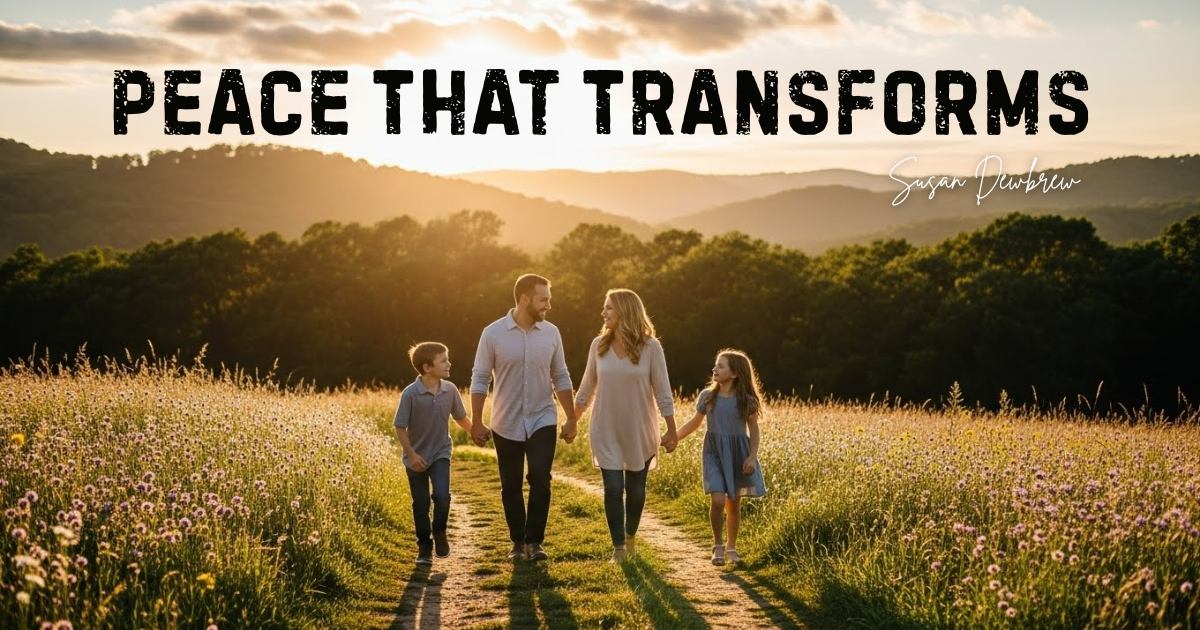
When you think of your city or wherever you call home—it's not just made up of buildings and businesses. Cities are comprised of people. Those buildings and businesses exist to serve people. People built them to give you a commodity, to give you a service, and you in turn give them resources that supply their families. It becomes this exchange.
But here's what I've discovered: the Shalom of the City doesn't just depend on individuals. It depends on families. Why? Because individuals are shaped and formed by their families. The peace and welfare you have depends on your family. How are things at home?
The peace of the city can't come without Shalom at home.
Peace You Can Feel
Gregory and I walk in a level of peace that goes beyond what the normal family experiences because it's something we've had to cultivate in our life. We actually have peace that we can share with you.
Every single person who visits our home will make the comment at some point: "You guys just carry so much peace in your house." It's tangible. You can feel it. It's not just that there's an absence of conflict. There's a presence of peace.
That's something we have that we can actually impart to others. And here's the thing about peace—it's not just the presence of the Lord. Yes, He is the Prince of Peace. But when the Prince of Peace comes and delivers it to you, it becomes something that's yours. It's tangible. It has substance.
It's like radio waves in the air. You might not be able to see them, but they exist and they carry things. That's what peace is like.
Shalom Means Everything
The word shalom means peace, but it means a whole lot more than peace. It actually has multiple attributes:
Peace and harmony - All players operating together in unison. When musicians play together, if one of them is off doing their own thing because they think they know better than the others, how would that sound? No harmony. Harmony requires yielding and flowing with one another. That creates peace.
Wholeness - We get the word "holy" from it. We get the word "healing" from it. Your insides are whole.
Completeness and prosperity - Prosperity in your finances. Prosperity in your work. Prosperity with your children. Prosperity meaning you don't have any lack whatsoever. You don't just have enough for yourself. You have plenty to share with others.
Welfare and safety - For those living in abusive relationships, for those working in really unsafe conditions, shalom brings you safety. Even in the middle of hard circumstances, shalom brings safety.
Contentment and tranquility - On the inside, where it matters most.
Shalom carries all these things with it. It's a substance. It's tangible. And it has the ability to release these things into your life.
Building Houses in Babylon
In Jeremiah 29, God speaks to His people living in exile in Babylon. These were people who had been carried away from Jerusalem because they'd begun to worship false gods. They ended up under the dominion of the very powers they'd turned to instead of the Lord.
But listen to what God tells them:
"Thus says the Lord of hosts, the God of Israel, to all the exiles whom I have sent into exile from Jerusalem to Babylon: Build houses and live in them; plant gardens and eat their produce. Take wives and have sons and daughters; take wives for your sons, and give your daughters in marriage, that they may bear sons and daughters; multiply there, and do not decrease. But seek the welfare of the city where I have sent you into exile, and pray to the Lord on its behalf, for in its welfare you will find your welfare" (Jeremiah 29:4-7, NRSV).
Despite their circumstances, God wanted them to understand: You're not going to get out tomorrow. So while you're living in a rough place, build houses. Plant your gardens. Eat them. Take care of yourself. Take care of your family. Live. Exist. Be healthy.
This is not just about you. This is about your children and your children's children and your children's children's children. Sometimes what we're going through, and sometimes what we need to cultivate in our lives, is bigger than us. We may have to live for a generation we'll never even see.
Do we understand how important every decision in our life is?
What Destroys Peace
I sit with people every week in inner healing sessions. There's not one person who wasn't impacted by their family of origin. Our cities are filled with people carrying wounds from their childhood, from trauma, from just living in selfishness.
It impacts us. And if we don't understand what we pass on to our children by how we speak to them, how we speak to our spouses, we're creating environments that are either filled with God's Kingdom or filled with the kingdom of darkness. There's no mixture. One is taking precedence over the other.
Which one are you empowering?
The one thing that kills peace in the home is selfishness. And selfishness is birthed out of fear. Selfishness breeds the need for control and the need for power. It can look a million different ways.
I can be selfish and just gently manipulate you to do my way, or I can make you do my way. I can give you Bible verses that say you better do it my way, or you're not in the will of God.
Selfishness kills shalom.
It's a Get-To, Not a Have-To
My husband Gregory has a core message, and he even wears it as a tattoo on his arm: "It's a get to."
He doesn't look at anything as "I have to," but "I get to."
Gregory waited 23 years after his first marriage ended before God brought us together. During those years, the Lord was transforming him. And what emerged was a man who approaches life—and our marriage—with the mindset of Jesus, who came "not to be served, but to serve" (Matthew 20:28, NIV).
When you think about it, most of our daily activities might look like traditional roles. I do most of the cooking, and Gregory takes care of the vehicles and anything nasty (like the mouse in the garage last week!). But here's the difference between our daily activities and the traditional mindset: I don't feel like I have to cook. There are many days I don't if I'm busy at work or simply tired. Gregory is perfectly capable of fixing us food. And I would have taken care of that mouse if he wasn't going to be home soon.
It's a "get to," not a "have to."
We both always pitch in, and we're both all-in with doing life together. It's not "your job" versus "my job." It's lending our strengths to our union, to our life.
Let me give you a small example of how this works. Gregory has a pet peeve about dishes in the sink. I try to walk in honor and remember, but when I don't, he never gets mad at me. He'll just put the dishes in the dishwasher.
And because he responds that way in love, the next time I'm getting ready to walk away from the sink, what do I want to do? I want to put them away to honor him, because I appreciate the way he responded.
It becomes reciprocal.
If he yelled at me and then just put them in, guess what? The next time I leave dishes in the sink, I'm either thinking, "Well, I better put them away because otherwise he's going to get mad at me," or "I ain't putting them away. He can't make me."
We cultivate mutual honor, mutual love, mutual respect. And it happens in the smallest of things. It's the little things. It's the small foxes that spoil the vine (Song of Solomon 2:15, NKJV).
When You Release Peace, It Multiplies
In Matthew 10:13, Jesus told His disciples to release their peace. He said, "If the household is worthy, let your peace come upon it; but if it is not worthy, let your peace return to you" (Matthew 10:13, NRSV).
Peace is a substance. It's something tangible. When you have it, you can give it away.
What does it mean for a household to be "worthy"? It doesn't mean they deserve it because they're good enough. It's a word that means "of equal weight." Luke, in the same context, says if the son of peace is there, the peace will remain. And if not, it will come back to you.
When you release your peace into the atmosphere—at home, at your workplace, in your interactions—when there's somebody else there with that equal measure in them, somebody else that Holy Spirit is stirring on the inside, they're going to catch hold of your peace.
There may be plenty that don't, and that's okay. Your peace will return to you. But that's how you spread it.
When you release your peace and it actually comes back to you, it grows. When you release love and Gregory gives it back to me, it grows.
The reason people walk in our house and tangibly feel peace isn't because we had an encounter with the Lord 30 years ago and that was it. We're going to have encounters with the Lord, and we're going to receive that tangible peace. But once we have it, what are we going to do with it?
Are we going to treat it like it has no value and just throw it aside? Are we still going to walk in selfishness?
If you do that, you destroy peace.
But when you choose—as an act of your free will—to yield, if the other person has equal weight, if the other person is listening to Holy Spirit, if the other person is willing in that moment to just say, "It's not that big a deal. I'm not going to fight. I'm just going to yield back," all of a sudden there's this momentum.
Everything in God's Kingdom is circular. It's like the Trinity. The Father, the Son, Holy Spirit—three in one. Mutual love, mutual respect, mutual submission. There's no subordination in the Trinity. That would be heresy. Jesus is equally God as the Father, is equally God as Holy Spirit.
And what we understand is that because of their union, their love relationship, power comes.
That kind of power doesn't come from selfishness. No amount of force in the world, no amount of selfishness creates the kind of peace that transforms.
The Peace That Brings Courage
Jesus actually gave His disciples His perfect peace. He said, "Peace I leave with you; my peace I give to you. I do not give to you as the world gives. Do not let your hearts be troubled, and do not let them be afraid" (John 14:27, NRSV).
In the Amplified version, it says His peace gives us courage and strength for everyday challenges.
Fear leads to selfishness. We begin to start protecting ourselves. Jesus says, "Don't be afraid." That's not just a little verse—that's actually a key. Don't be afraid. Let My perfect peace calm you in every circumstance.
His peace that He gives us provides courage for those everyday circumstances that release Shalom at home. It releases peace in our house, and it's that peace that brings the prosperity, that brings the wholeness, that brings the financial provision, that brings the physical healing.
Most of our diseases are caused because the body's been under stress for so many years, often from childhood wounding. Science is just now figuring that out. Peace ushers in the healing and the wholeness and the things that come from the inside out.
You get that creative idea. You have the courage to start the business. You're not taking from your neighbor. You're reaping what you sow.
And instead of sowing discord and victimhood and all of these low-level frequencies, you're stepping up into God's Kingdom that says, "I have the God of the universe living on the inside of me. He's the King of Peace. I'm not going to let this bother me."
Your Choice Today
Peace is tangible. It's something you can physically receive. Jesus said, "My peace I give you." He told the disciples to release their peace. It's something that can be transferred.
What Gregory and I have cultivated, we want to share with you. But here's the thing: once you receive it, it's your choice what you do with it.
Will you choose to cultivate it? To let it grow?
When you do, you'll find that the peace planted in your heart begins to transform your mind, your will, your emotions. It will begin to transform your finances, your physical body. Shalom means nothing missing and nothing broken.
And if you're not seeing the results immediately, just as the Jews in Babylon didn't see them immediately, it doesn't mean it's not coming to pass. The enemy wants to bring discouragement so you let go of the promise.
But if you hold on, Galatians 6:9 says, "Let us not grow weary in doing what is right, for we will reap at harvest time, if we do not give up" (NRSV).
You will reap a reward. You will.
The Shalom of the City comes from the Shalom of the Family. And the Shalom of the Family begins with you choosing peace today.
Blessings,
Susan 😊