
Raising Sensitive Sons in a Toxic Masculinity Culture
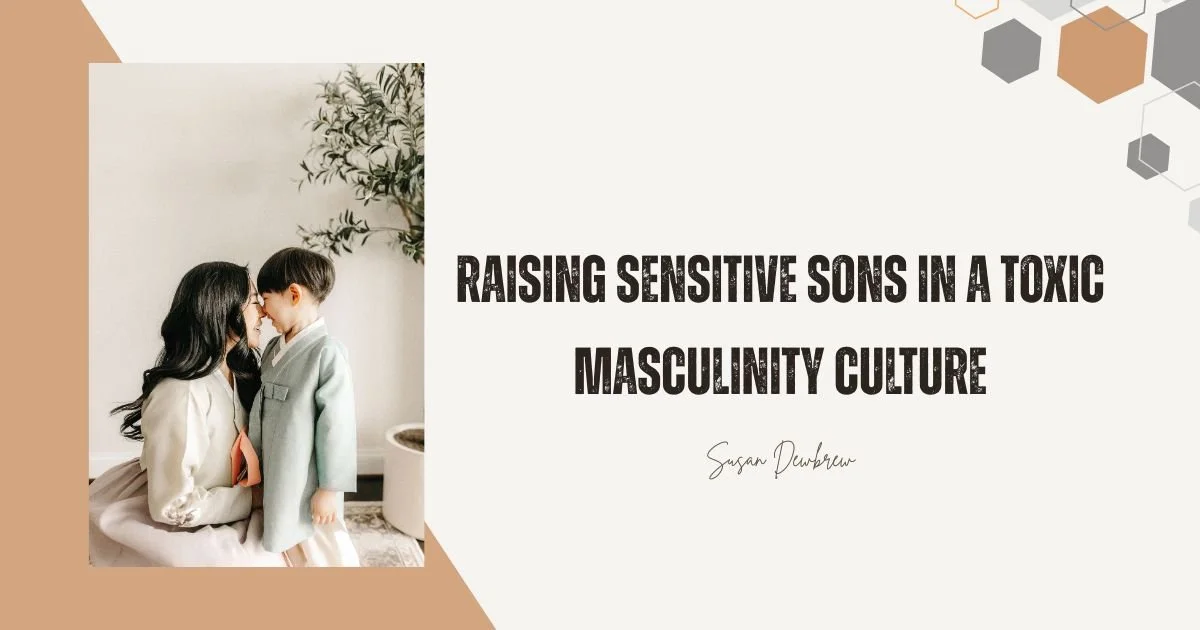
I'll never forget the conversation I had with one of my sons about his sensitivity. He'd internalized the message that being sensitive somehow made him weak or less masculine. My heart broke as I watched this beautiful, compassionate young man question whether his natural empathy was a flaw to be overcome rather than a gift to be celebrated.
"It's a superpower, dude," I told him. "That sensitivity is awesome."
But I could see the confusion in his eyes. Everything in our culture had taught him otherwise.
The False Binary
Our society—and sadly, much of the church—has created rigid boxes for what makes someone masculine or feminine. Sensitivity, nurturing, emotional intelligence, gentleness, love of beauty, artistic expression? Those are labeled "feminine" traits. Aggression, stoicism, physical strength, leadership, analytical thinking? Those are "masculine."
But here's the problem with this binary thinking: it's not biblical, it's not healthy, and it's certainly not helping our children thrive.
When we force human beings into these narrow categories, we inevitably wound those who don't fit the prescribed molds. We tell sensitive boys they're "acting like girls" and assertive girls they're "too masculine." We shame children for expressing parts of their God-given personalities simply because those traits have been arbitrarily assigned to the "wrong" gender.
The Crisis of Gender Confusion
What breaks my heart is how this rigid gender role thinking is actually contributing to the gender confusion epidemic we're seeing among young people today. When a sensitive boy is consistently told he's "acting like a girl," when he likes activities that have been labeled "feminine," when his natural empathy and emotional intelligence are seen as weaknesses rather than strengths, is it any wonder that some boys begin to question their very identity?
The same thing happens with girls who are natural leaders, who are assertive, who prefer activities that have been labeled "masculine." They're told they're not acting like "real girls," that they need to be more submissive, more gentle, more accommodating.
We've created such polarities around gender that children who don't fit our artificial categories begin to wonder if they were born in the wrong body rather than recognizing that our categories are what's wrong.
As the podcast conversation revealed, there's been a 400% spike in kids identifying as gay, trans, or non-binary—many before they've even reached puberty. While there may be various factors contributing to this phenomenon, we cannot ignore how our rigid gender role expectations create confusion and shame around natural personality differences.
The Church's Role in the Problem
Unfortunately, the church has often been a leader in creating and enforcing these harmful gender stereotypes. We've taken cultural assumptions about masculinity and femininity and baptized them as "biblical truth."
We've taught that men must be leaders, providers, and protectors while women must be followers, nurturers, and supporters. We've insisted that men should be strong and stoic while women should be gentle and emotional. We've created elaborate theological systems to defend these cultural constructs.
But when you actually study Scripture, you discover that God's design for humanity is far more expansive than our narrow categories suggest.
Biblical Examples of Expansive Masculinity
The Bible is full of men who displayed what our culture might label "feminine" traits:
Jesus was incredibly nurturing. He wept openly (John 11:35, ESV). He gathered children in His arms and blessed them (Mark 10:16, ESV). He compared Himself to a mother hen wanting to gather her chicks (Matthew 23:37, ESV). He consistently showed emotional intelligence, empathy, and tenderness.
David was a poet and musician who wrote vulnerable, emotionally expressive psalms. He wasn't ashamed to dance with abandon before the Lord (2 Samuel 6:14, ESV). He had deep, affectionate friendships with both men and women.
John was known as the "beloved disciple" who leaned on Jesus' chest (John 13:23, ESV). He wrote extensively about love and relationship. His gospel and letters are filled with emotional sensitivity and spiritual tenderness.
These men weren't considered less masculine because of these qualities—they were considered whole human beings expressing the full range of characteristics that reflect God's image.
Biblical Examples of Strong Women
Similarly, Scripture celebrates women who displayed what our culture might label "masculine" traits:
Deborah was a judge and military leader who led Israel to victory in battle (Judges 4, ESV). Her authority wasn't questioned because of her gender—it was celebrated because of her wisdom and relationship with God.
Priscilla taught theology to the eloquent Apollos, helping him understand the way of God more accurately (Acts 18:26, ESV). She was a co-worker with Paul in ministry.
The Proverbs 31 woman was an entrepreneur who bought fields, planted vineyards, and traded profitably (Proverbs 31:16-18, ESV). She was strong, dignified, and spoke with wisdom and kindness.
None of these women were considered less feminine because of their strength, leadership, or business acumen—they were celebrated as examples of godly womanhood.
Reclaiming Full Humanity
What if instead of forcing our children into gender boxes, we celebrated the full range of human qualities as reflections of God's image? What if we understood that both men and women are created to embody strength and tenderness, leadership and service, courage and compassion?
This doesn't mean there are no differences between men and women. There are biological realities and sometimes different life experiences that can influence our perspectives and approaches. But these differences don't require rigid role assignments or hierarchical structures.
In God's Kingdom, we're called to "submit to one another out of reverence for Christ" (Ephesians 5:21, ESV). This mutual submission allows both men and women to lead when their gifts are needed and follow when someone else's gifts are more relevant.
Practical Implications for Parenting
As parents, we have the opportunity to raise children who reflect the full image of God rather than narrow cultural stereotypes. This means:
Celebrating all aspects of our children's personalities: If your son is sensitive and nurturing, affirm those qualities as strengths. If your daughter is assertive and analytical, encourage her leadership gifts.
Modeling expansive gender roles: Let your children see men who are emotionally intelligent and women who are strong leaders. Show them marriages where both partners lead and follow as appropriate.
Questioning cultural messages: When your child absorbs harmful gender stereotypes from peers, media, or even church, help them think critically about whether these messages align with God's design for humanity.
Teaching them about Jesus: Show your children how Jesus embodied both strength and tenderness, courage and compassion, leadership and service. Help them understand that following Christ means embracing the full range of human qualities.
The Church's Opportunity
The church has a crucial opportunity right now to be part of the solution rather than part of the problem. As culture becomes increasingly aware of the harm caused by rigid gender roles, we can lead the way in demonstrating a more biblical approach to masculinity and femininity.
We can teach that true masculinity isn't about domination but about using strength to protect and empower others—just as Christ used His power to serve rather than to control.
We can show that true femininity isn't about weakness but about the unique perspectives and gifts that women bring to leadership, ministry, and family life.
We can model marriages and communities where both men and women are encouraged to develop their full potential in service to God's Kingdom.
A Vision for Wholeness
Imagine a generation of young men who feel free to be both strong and sensitive, who can lead with wisdom and follow with humility, who see nurturing and empathy as strengths rather than weaknesses.
Imagine a generation of young women who feel free to be both gentle and assertive, who can serve with grace and lead with confidence, who see their voices and perspectives as valuable contributions to God's Kingdom.
This isn't about eliminating all distinctions between men and women—it's about eliminating the artificial constraints that prevent both from reflecting the full image of God.
When we free our children from the prison of gender stereotypes, we're not making them confused about their identity—we're helping them discover their true identity as beloved children of God, created to reflect His character in all its beautiful complexity.
Our sensitive sons aren't broken boys who need to be toughened up. They're whole human beings whose empathy and emotional intelligence are desperately needed in a world that has forgotten how to love well.
Our strong daughters aren't rebellious girls who need to be subdued. They're whole human beings whose leadership and wisdom are essential for building God's Kingdom on earth.
The time has come to embrace the beautiful diversity of how God has created us and to raise children who are free to be fully human, fully alive, and fully reflective of their Creator's heart.
Blessings,
Susan 😊