
The Head Covering Controversy: When Jewish Paul Contradicts Jewish Culture
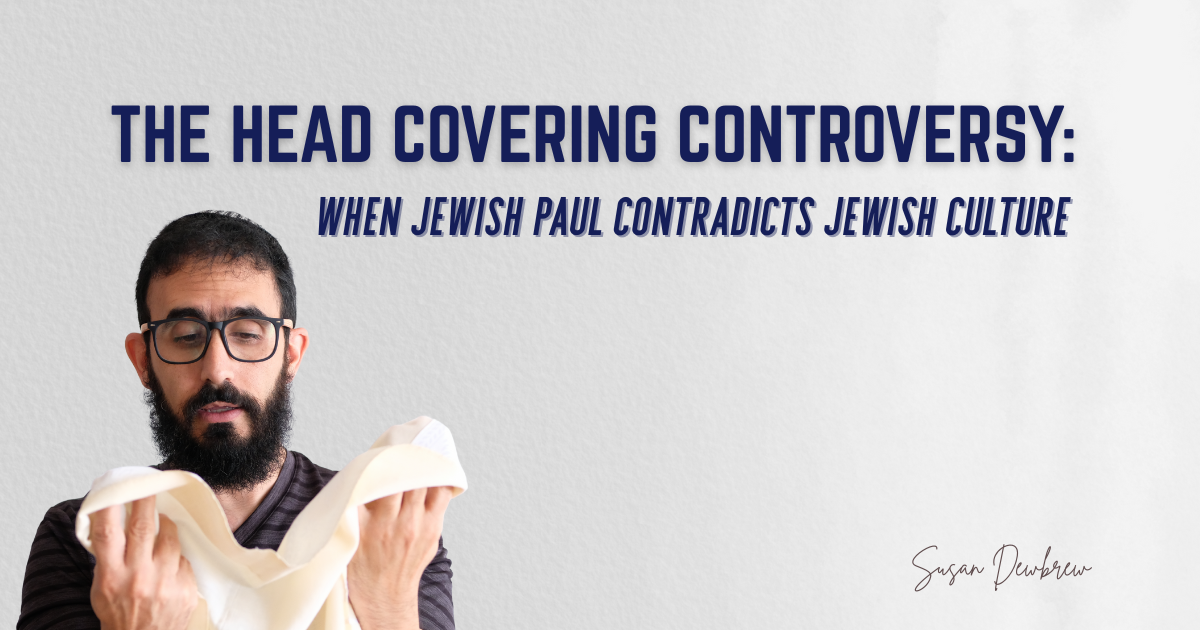
Imagine a Jewish Pharisee telling Jewish men they can't pray with their prayer shawls. That's exactly what 1 Corinthians 11 appears to say - if you read it wrong. But when you understand Jewish culture and Paul's background, you realize something much deeper is happening here.
The Prayer Shawl That Changed Everything
Paul wasn't just any Jewish man - he was a Pharisee, trained under Gamaliel, steeped in Jewish tradition. In his culture, every knot and tassel on the prayer shawl was attached to a biblical law. They didn't have printed Bibles back then, so men would literally run their fingers over the strings and knots, quoting verses. It was like their mini-Bible.
The word "Talit" actually means "little tent." When Jewish men went to pray, they would take that prayer shawl and flip it up over their heads, creating their own little prayer closet - their secret place with God. When they lifted their hands in praise, the garment would come up and look like wings. The corners were actually called "wings."
This is likely what people reached for when they touched the hem of Jesus' garment to receive healing. Malachi had prophesied there would be "healing in his wings" (Malachi 4:2, ESV), and the wings of the prayer shawl would have been the natural connection.
The Red Flag We Missed
So when Paul supposedly says in 1 Corinthians 11:4, "Every man who has something on his head while praying or prophesying disgraces his head" (NASB), this should have been a massive red flag.
Why would Paul, the preacher of freedom from the law, suddenly institute a new law that contradicted everything he knew about worship? Why would a Jewish Pharisee tell men they couldn't cover their heads to pray when that's exactly how he was raised to commune with God?
In my previous world, we actually took this seriously. We believed men had to keep their hair short and couldn't wear hats during prayer. But we struggled with the contradiction. How do you explain that Paul, who said we're free from the law, was now adding new rules about how to dress for prayer?
The Pattern Throughout 1 Corinthians
Here's what we missed: Paul was quoting them, not agreeing with them. Throughout 1 Corinthians, Paul uses a rhetorical method where he quotes the Corinthians' letter and then corrects their false teaching.
In chapter 7, verse 1, he explicitly says, "Now concerning the things about which you wrote to me..." (NASB). Then he addresses their statements one by one. Some translations even put quotes around the statements Paul is addressing because scholars recognize he's quoting them before responding.
The same pattern happens throughout the letter. Paul quotes what they're saying, then responds with "But..." or "However..." to correct them.
The False Teachers' Agenda
So what was really happening in Corinth? False teachers were trying to bring believers back under legalistic rules. They were saying:
Men must pray with uncovered heads (contradicting Jewish practice)
Women must cover their heads and keep their hair uncut
This was all based on a hierarchical understanding of creation
Women were created for men, so they needed symbols of authority on their heads "because of the angels"
Paul was quoting these false teachings to expose and correct them. He wasn't endorsing new rules - he was dismantling legalistic systems that would put believers back under bondage.
The Correction
Look at how Paul responds in verse 11: "However, in the Lord, neither is woman independent of man, nor is man independent of woman" (1 Corinthians 11:11, NASB).
There's that word "however" - he's correcting what he just quoted. The false teachers were creating hierarchy based on creation order. Paul levels the playing field: "For as the woman originates from the man, so also the man has his birth through the woman; and all things originate from God" (1 Corinthians 11:12, NASB).
It's brilliant. In just a few words, Paul dismantles their entire argument. Yes, woman came from man originally, but now all men come from women. You can't use "who came from whom" to establish authority because it goes both ways. And ultimately, all things originate from God.
The Questions That Expose the Lie
Then Paul asks pointed questions that expose the absurdity of their position:
"Judge for yourselves: is it proper for a woman to pray to God with her head uncovered? Does not even nature itself teach you that if a man has long hair, it is a dishonor to him, but if a woman has long hair, it is a glory to her?" (1 Corinthians 11:13-15, NASB).
These aren't rhetorical questions supporting head coverings - they're questions that force examination of the claims. And when you examine them honestly, they fall apart.
Does nature teach us that long hair is shameful on men? Ask the lion with his magnificent mane. Ask the peacock with his flowing feathers. Ask any Native American warrior who ever lived. Nature doesn't teach us anything about appropriate hair length based on gender.
The Final Word
Paul concludes with what should have been the end of the debate: "But if anyone seems to be contentious, we have no such practice, nor do the churches of God" (1 Corinthians 11:16, NASB).
The Greek word here is "toioutos" - meaning "of this sort." Paul isn't saying they have no other practice. He's saying they don't practice these things at all. Head coverings, hair length rules, hierarchical submission based on creation order - none of it.
We have no such practice. Neither do the churches of God. It's a complete rejection of the legalistic system the false teachers were promoting.
The Freedom This Brings
When I finally understood this, it was liberating. All those years of trying to reconcile Paul's freedom message with apparent new rules about hair and head coverings - it finally made sense.
Paul wasn't contradicting himself. He wasn't adding new laws. He was doing what he always did - setting people free from religious systems that would put them back under bondage.
The same Paul who wrote about our freedom in Christ was consistently opposing those who would limit that freedom through external rules and hierarchical systems. Whether it was circumcision, dietary laws, or gender-based restrictions, Paul's message was always the same: Christ has set us free.
Why This Matters Today
This understanding matters because churches still struggle with these passages. Some enforce literal head coverings or hair length rules. Others use these verses to support "spiritual covering" where women must be under male authority.
But Paul's actual message is freedom. Men can have long hair if they want. Women can have short hair if they want. Neither needs to worry about angels judging their appearance. Your glory comes from the Lord, not from your hair length or head covering.
The Jewish Paul who grew up covering his head to pray wasn't suddenly instituting rules against head coverings. He was exposing and correcting false teaching that would steal the freedom Christ purchased for us.
When we understand Paul's rhetorical method and Jewish background, 1 Corinthians 11 becomes not a source of rules and restrictions, but a powerful defense of our freedom in Christ. And that freedom is still available to us today.
A Personal Note
I spent years trying to make sense of this passage from a traditional perspective. I lived and defended these hair length rules, believing I was being faithful to Scripture. But when something doesn't make sense, maybe the problem isn't with Scripture - maybe it's with our interpretation.
Understanding Paul's Jewish background and rhetorical method didn't weaken my faith in Scripture - it strengthened it. It showed me that Paul was even more consistent than I'd realized. The apostle of grace was always the apostle of grace, even when false teachers tried to drag believers back under law.
That's the Paul I can follow. That's the message I can proclaim. Not rules and restrictions, but freedom in Christ - the freedom to be fully who God created us to be, without the limitations that religious systems would impose.
Have you struggled with passages that seemed to contradict the gospel of grace? How has understanding context changed your relationship with Scripture? I'd love to hear your thoughts in the comments below.
Blessings,
Susan 😊