
The Racism Test: Where Unity Gets Real
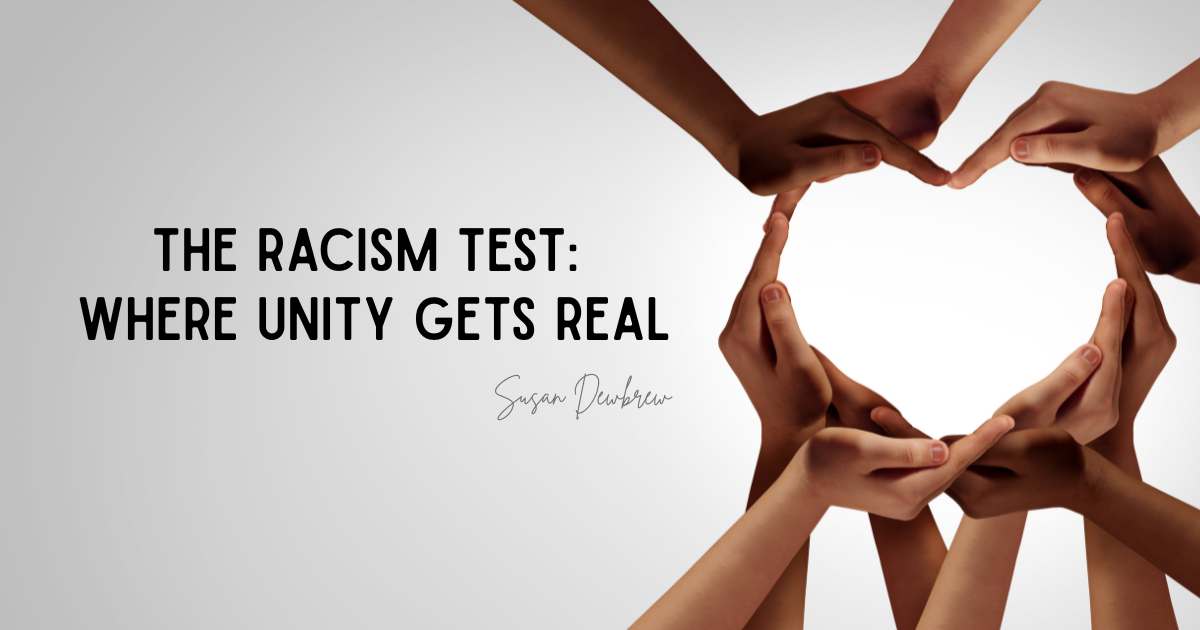
In my journey of understanding God's heart for unity, I've discovered that our approach to racial reconciliation reveals everything about whether we truly grasp Kingdom principles or if we're still operating from worldly power structures.
The same hierarchical thinking that has subjugated women for centuries is the same thinking that has perpetuated racial division. Both are rooted in the false belief that some people are inherently more valuable, more capable, or more deserving of power than others.
The Deep Root of Division
After years of studying Scripture and observing human behavior, I've come to understand that most of our conflicts—whether based on gender, race, denomination, or politics—stem from the same poisonous root: dominance-based hierarchy.
This is the world's system, where power flows in one direction, where being "on top" means others must be "on bottom," where winning requires someone else to lose. It's the system of empire, of conquest, of "us versus them."
But the Kingdom of God operates on completely different principles. In God's Kingdom:
Power flows in all directions
Authority means responsibility to serve
Leadership equals lifting others up
Success means bringing everyone up together
The Mirror of Our Hearts
Here's what I've noticed: how we respond to conversations about racial justice reveals which kingdom we're really operating from.
If we immediately get defensive, if we start talking about "reverse racism," if we're more concerned about being labeled racist than we are about actual racism—these responses often indicate we're still thinking hierarchically. We're worried about losing position rather than concerned about others gaining dignity.
But if we can listen with curious hearts, if we can acknowledge painful realities without feeling personally attacked, if we can celebrate progress toward equality without feeling threatened—this suggests we're beginning to think from Kingdom principles.
The Relationship Principle
I love this simple but profound truth: racism cannot survive in authentic relationship.
When you develop a genuine relationship with someone, they stop being a category or a statistic and become a real person. Their struggles become your concern. Their children's futures matter to you. Their perspectives challenge and enrich your understanding.
This is why segregation was so crucial to maintaining racist systems. As long as people remained separated, it was easy to maintain stereotypes and assumptions. But when people actually got to know each other, the lies that fuel prejudice began to crumble.
Learning from My Own Journey
My journey on gender equality has taught me so much about how change happens in other areas too. For years, I accepted traditional teaching about women's roles without question. It was what I'd been taught, what seemed biblical, what everyone around me believed.
But as I began to study Scripture more deeply, as I examined the cultural context of biblical passages, as I saw the fruit of hierarchical systems in real relationships—including my own first marriage—I realized I'd been accepting man-made interpretations rather than God's original design.
The same process has happened with racial issues. Growing up in environments where racial inequality was simply accepted as "normal," I had to learn to see through God's eyes rather than through the lens of cultural conditioning.
The Kingdom Lens
When I look at racial division through a Kingdom lens, several things become clear:
First, every person bears God's image equally. Genesis 1:27 doesn't say that only certain races or ethnicities bear God's image. Every human being—regardless of skin color, ethnicity, or cultural background—is an image-bearer of the Most High God.
Second, God intentionally created diversity. The vision of heaven in Revelation 7:9 shows "a great multitude that no one could count, from every nation, tribe, people and language" worshiping together. Diversity isn't a problem to solve—it's God's design to celebrate.
Third, the Gospel breaks down dividing walls. Paul declared in Galatians 3:28 (NIV) that "there is neither Jew nor Gentile, neither slave nor free, nor is there male and female, for you are all one in Christ Jesus." The Gospel doesn't just save individuals; it dismantles the systems that separate us.
The Fruit Test
Jesus taught us to recognize truth by its fruit (Matthew 7:16 NIV). So what fruit have hierarchical racial systems produced?
Generational trauma and poverty
Educational and economic disparities
Mass incarceration and injustice
Violence and hatred
Fear and suspicion
Broken communities and families
These are not the fruits of the Spirit. These are not reflections of God's Kingdom.
Conversely, when we see racial reconciliation happening—when we see authentic relationships forming across racial lines, when we see systemic barriers being dismantled, when we see communities flourishing together—we see glimpses of God's Kingdom breaking through.
Beyond Guilt to Partnership
I've learned that racial reconciliation isn't about white people feeling guilty or people of color being grateful. It's about all of us recognizing that we've been robbed—robbed of the richness that comes from authentic diversity, robbed of the full expression of God's Kingdom on earth.
When churches are predominantly one race, when neighborhoods are segregated, when our social circles lack diversity, we're missing out on the fullness of what God intended. We're experiencing a diminished version of Kingdom life.
The goal isn't for white people to save people of color, or for people of color to educate white people. The goal is partnership—working together to dismantle systems that harm us all and build communities that reflect heaven's diversity.
Practical Steps Forward
So how do we move beyond good intentions to real change? Here are some practical steps I've learned:
Listen more than you speak. When people share their experiences with racism, believe them. Don't minimize, explain away, or compare their struggles to your own. Just listen and learn.
Examine your own heart. Ask the Holy Spirit to reveal any areas where you've unconsciously absorbed racist thinking. Be willing to repent and change.
Build authentic relationships. If your social circle, church, or workplace lacks diversity, that's worth examining. Seek opportunities to build genuine friendships across racial lines.
Use your influence. Whatever platform or influence you have—in your family, workplace, church, or community—use it to promote justice and reconciliation.
Support systemic change. Individual relationships are crucial, but they're not enough. We also need to address policies and systems that perpetuate inequality.
The Vision Fulfilled
Remember the prophetic vision I shared about the tug-of-war? I believe racial reconciliation is one of the key areas where Jesus is lifting the rope and bringing us together around the well of living water.
For too long, we've been fighting over who's more oppressed, who's more privileged, who should have what position in society. Meanwhile, people of all races have been unable to reach the healing and wholeness they need because of our divisions.
But as we come together around Christ—as we recognize our equal value in His eyes, as we celebrate the diversity He created, as we work together for justice and healing—we become a powerful witness to the world of what God's Kingdom looks like.
The Test of Our Faith
In many ways, our response to racial injustice has become a test of whether we really believe what we say we believe about the Gospel.
Do we really believe all people are created equal? Do we really believe in justice and mercy? Do we really believe love should drive out fear? Do we really believe in the power of the Gospel to transform not just individuals but systems?
The world is watching our answers. They're not looking at our theology papers or our church doctrines. They're looking at how we treat the most vulnerable, how we respond to injustice, how we love across differences.
Love Wins
Here's what I know for certain: love wins. The Kingdom of God will ultimately prevail over every system of oppression and division. The question isn't whether justice will come—it's whether we'll be part of bringing it or whether we'll continue to resist it.
I choose to be part of the solution. I choose to examine my own heart, build authentic relationships, and use whatever influence I have to promote healing and reconciliation.
Because at the end of the day, we're all just thirsty people trying to reach the same well. And Jesus is standing there, inviting everyone to come and drink freely.
The rope is being lifted. The dividing walls are coming down. The Kingdom is advancing.
And love wins.
Blessings,
Susan 😊