
The Two Trees and Two Kingdoms: Why Knowledge Isn't Enough
Here's something that might surprise you: you can have perfect biblical interpretation and still build the wrong kingdom.
I learned this the hard way. After discovering that centuries of church teaching about women had been based on misunderstandings of Scripture, I was excited to share this revelation with others. I had the facts. I had the Greek word studies. I had the historical context. I was ready to set people free with the truth.
But what I discovered was sobering: information alone doesn't transform hearts. You can win every theological argument and still lose people's hearts. You can be absolutely right and still operate in the wrong spirit.
The Two Trees in Eden
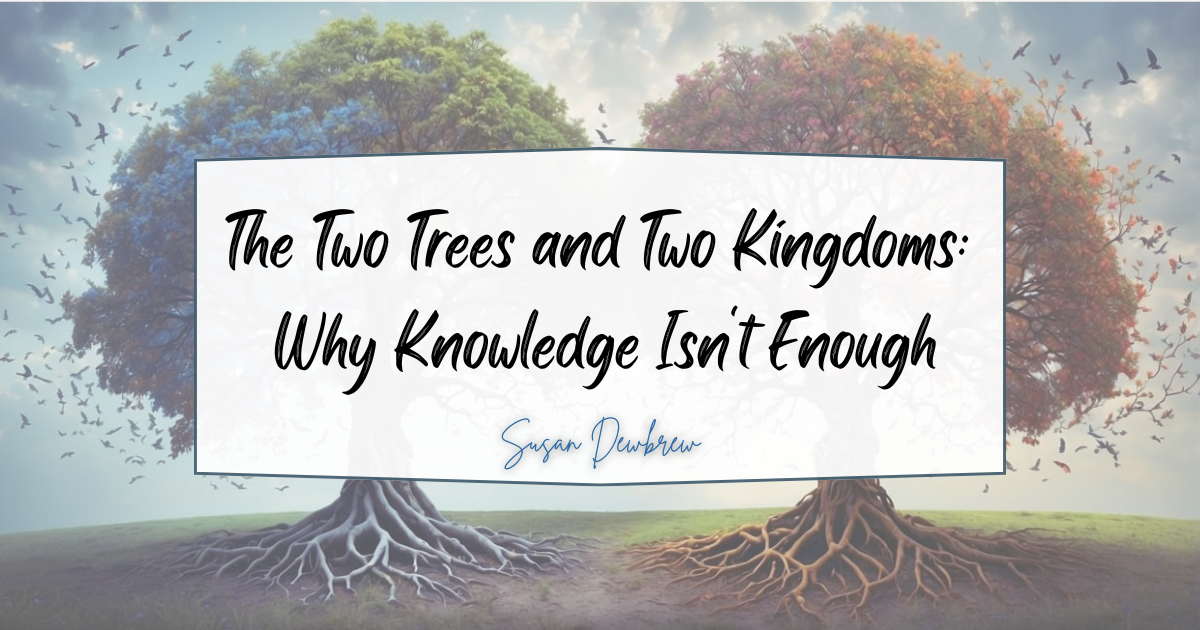
The story of the two trees in Eden illustrates this perfectly. God placed two trees in the center of the garden: the Tree of Life and the Tree of the Knowledge of Good and Evil.
Notice that the forbidden tree wasn't the Tree of Evil—it was the Tree of the Knowledge of Good and Evil. Knowledge, even accurate knowledge about good and evil, wasn't enough. In fact, pursuing knowledge apart from relationship with God led to death rather than life.
The Tree of Life represented something different: intimate relationship with God, dependence on His life flowing through us, trust in His goodness rather than reliance on our own understanding.
Two Kingdoms Operating with Different Rules
This same principle applies to how we approach the question of relationships between men and women. There are essentially two kingdoms operating with completely different rules:
The World's Kingdom operates through:
Demanding rights and fighting for position
Using facts as weapons to win arguments
Forcing compliance through pressure and guilt
Separating from those who disagree with us
Building our identity on being right
Operating in our own strength and wisdom
God's Kingdom operates through:
Demonstrating love that draws people to truth
Using facts as tools for understanding and healing
Influencing hearts through genuine transformation
Staying connected even with those who see things differently
Building our identity on being loved by God
Operating in dependence on His Spirit and grace
The Danger of Right Information, Wrong Kingdom
I've seen this play out countless times in my own journey and in conversations with others. Someone discovers that Scripture actually teaches mutual submission rather than male authority. They get excited about this truth (as they should!). But then they go out and try to advance this truth using the world's methods rather than Kingdom methods.
They might:
Demand that their husband immediately change his understanding of marriage
Use their new knowledge to shame those who still hold traditional views
Leave their church in anger rather than trying to lovingly plant seeds
Become critical and judgmental toward those who haven't "seen the light" yet
Fight for women's rights in ways that alienate the very men whose hearts need to change
The information is correct, but the kingdom being used to advance it is wrong.
Why This Matters So Much
Here's the problem with using worldly methods to advance Kingdom truth: it produces worldly fruit even when the content is right.
When we demand our rights rather than demonstrating God's love, we might win some battles but we lose hearts. When we use shame and pressure rather than grace and patience, we might force external compliance but we don't create internal transformation.
Worse, we can actually harden hearts against the very truth we're trying to communicate. People associate our message with our methods, and if our methods feel harsh or controlling, they'll resist our message even if it's true.
Jesus's Example
Jesus faced this exact choice. He had every right to demand that people recognize His authority. He could have used His power to force compliance. He could have shamed the religious leaders who opposed Him or abandoned the disciples who were slow to understand.
Instead, He chose a different path. He served rather than demanded service. He washed feet rather than expecting His feet to be washed. He laid down His life rather than asserting His rights.
This wasn't weakness—it was Kingdom strength. And it transformed the world in ways that force never could.
Practical Kingdom Methods
So what does it look like to advance the truth of mutual submission using Kingdom methods rather than worldly ones?
In Marriage:
Instead of demanding that your husband change his views, embody the freedom and security that comes from understanding your true worth in Christ
Rather than criticizing his leadership style, demonstrate servant leadership yourself
Instead of fighting for equality, live out the mutual honor you want to see
In Church:
Rather than demanding recognition of women's gifts, use your gifts excellently wherever you have opportunity
Instead of criticizing male leadership, support and encourage men while staying true to your calling
Rather than leaving in anger, plant seeds of Kingdom truth through relationship and example
In Conversations:
Instead of trying to win arguments, seek to understand others' perspectives and share your own with humility
Rather than using Scripture as a weapon, use it as a bridge to deeper relationship
Instead of demanding agreement, focus on demonstrating the fruit of what you believe
The Power of Love
What I've discovered is that love is far more powerful than force. When people see the joy, freedom, and flourishing that comes from Kingdom relationships, they become hungry for what you have rather than defensive about what they believe.
My husband Gregory embodies this perfectly. His strength has never been used to intimidate or control me. Instead, his power creates safety for me to flourish. This demonstrates Kingdom masculinity in a way that no argument ever could.
When people see our marriage, they don't become defensive about male authority—they become curious about what makes our relationship so different. They're drawn to the life they see rather than feeling threatened by the theology they hear.
The Fruit Test
Jesus said we would know trees by their fruit. This applies not just to what we believe but to how we advance what we believe.
If our methods produce division, bitterness, defensiveness, and resistance, we might be using the right information but operating from the wrong tree.
If our methods produce curiosity, hunger for God, transformation of hearts, and lasting change, we're likely operating from the Tree of Life even if our journey toward truth is still in progress.
A Call to Kingdom Methods
The truth about mutual submission is beautiful and liberating. But the way we advance this truth matters just as much as the truth itself.
We don't need to choose between being faithful to Scripture and being gracious to people. We don't need to compromise truth in order to maintain relationships. We can hold fast to what we believe while demonstrating the love that makes our beliefs attractive.
The hearts of men—and women—are becoming ready to receive this truth. But they're more likely to receive it from us if it comes wrapped in grace rather than wielded as a weapon.
The Kingdom Is Advancing
I believe we're living in a time when God is restoring His original design for relationships—relationships built on mutual honor rather than dominance and control. But this restoration won't happen through force or manipulation. It will happen as hearts are transformed by encountering the love of God expressed through His people.
So let's be people who operate from the Tree of Life rather than the Tree of Knowledge. Let's build God's Kingdom using God's methods. Let's trust that love really is more powerful than force and that truth demonstrated in grace will ultimately prevail.
The revolution is happening—but it's a revolution of love, not a revolt of force. And that makes all the difference.
How have you seen the difference between demanding rights and demonstrating love in your own relationships?
Blessings,
Susan 😊