
When Ministers Fall (They’re Building the Wrong Kingdom)
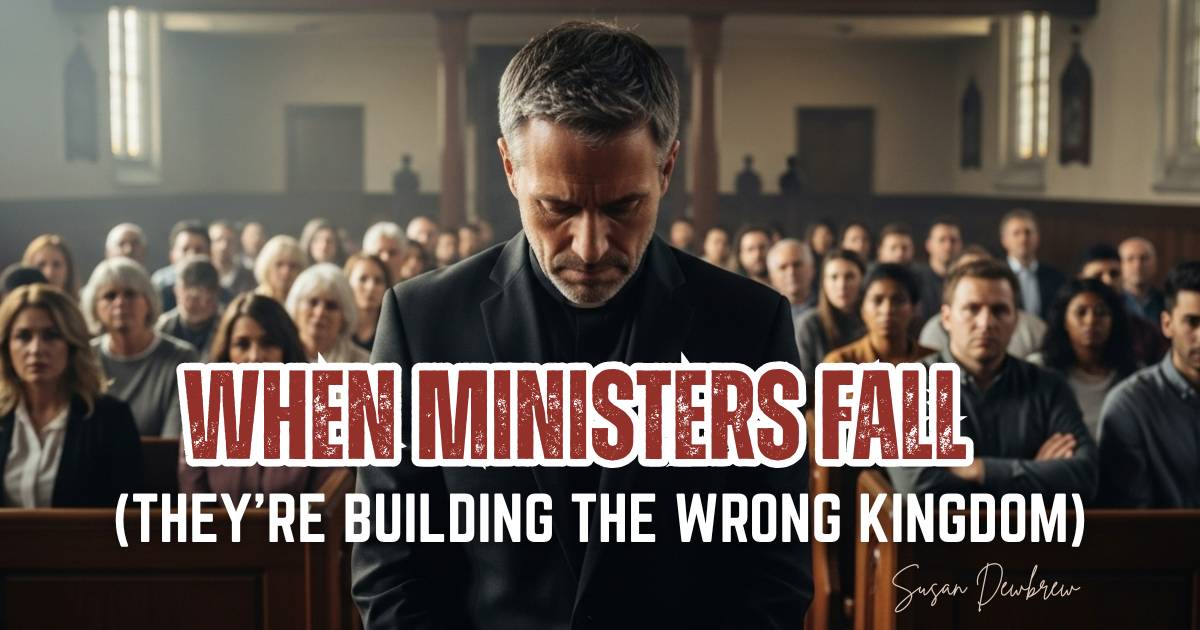
TThe news keeps coming. Another minister exposed for abuse. Another leader fallen. Shawn Bolz, Todd White, and countless others whose names have become synonymous with manipulation, financial exploitation, and sexual abuse. As Christians, we're grieving. We're embarrassed. Some are even questioning their faith.
But here's what I want you to understand: This isn't God's fault.
These scandals aren't just about individual bad actors or moral failures. They're symptoms of a much deeper problem—we've been building kingdoms that look nothing like the Kingdom of God. We've twisted the dominion mandate into domination, and in doing so, we've created the perfect breeding ground for corruption.
The Dominion We Were Given
Let's go back to the beginning. When God created humanity—male and female—He gave us dominion. Genesis is clear about what that dominion covered: the fish of the sea, the birds of the air, everything that creeps on the earth, the plants, the land itself.
But notice what's missing from that list: each other.
God never gave us dominion over other people. We were never meant to dominate, control, or use one another. We were supposed to take that garden—that place where God's presence and authority were welcomed—and spread it across the face of the planet. Together. As partners. As equals bearing the image of God.
The dominion mandate was about stewarding creation, not subjugating people.
Two Kingdoms, Two Operating Systems
Here's where it gets critical. There are two kingdoms operating in the spiritual realm, and they have fundamentally different power structures.
The kingdom of darkness operates on hierarchy and extraction. It's a pyramid. Power flows up. Those at the top consume the energy, resources, time, and loyalty of those below them. It's parasitic. Someone has to lose for someone else to win. The rich get richer because the poor get poorer.
The Kingdom of God also has structure—there are levels of authority, responsibility, and leadership. But the power doesn't come from dominating others or extracting their resources. Jesus demonstrated this clearly.
After His baptism, He was driven into the wilderness. He fasted for forty days, laying aside His fleshly needs to connect with the Father, to submit His will voluntarily—not by coercion, not by manipulation. And Scripture tells us He "returned in the power of the Spirit" (Luke 4:14).
That's the key difference. In God's Kingdom, power comes from connection with the Lord, not from using people.
When the Wrong Kingdom Infiltrates the Church
Now here's the tragic part. When we build church structures that mirror the enemy's pyramid system instead of Jesus's servant leadership, we create an environment where corruption can thrive.
Think about it. If you structure a church with one person at the top—the "man of God"—who everyone must obey, serve, and financially support without question, what have you created? You've created a field day for narcissists and predators.
I've even heard of mobsters who said when they get out of prison, they won't go back into organized crime—they'll start a church. Why? Because it's more lucrative and it's legal. You get people to work for you for free. You get them to give you ten percent of their income. You get them to surrender their sovereign will to yours.
That's not the Jesus we see in the Gospels. That's the Pharisees.
How Good People Get Corrupted
Here's what makes this even more heartbreaking: most ministers who fall didn't start out evil. They began with genuine hearts to serve the Lord. But power corrupts, especially when the structure itself is corrupted.
The fear of man creeps in. The pressure to keep the machine running, the bills paid, the lights on, the salaries flowing. The need to provide for their families and maintain their reputation. And slowly, imperceptibly, they start using people instead of serving them.
Once you cross that line—once you begin to see people as resources for your vision rather than sheep you're called to protect—you've opened the door to the enemy's kingdom. And sexual sin, financial manipulation, and abuse of authority are just the inevitable outworkings of that fundamental shift.
Sexual sin is particularly insidious because it penetrates all three levels of our being: body, soul, and spirit. It opens portals into the spiritual realm that give the enemy access. And when you combine that with the abuse of spiritual authority—convincing someone they're "helping the Lord" by submitting to you—it becomes one of the darkest expressions of the kingdom of darkness operating through religious structures.
My Own Experience
I know this isn't just theory. I've lived it.
We served faithfully at a church for four years. I gave generously—even employed the pastor full-time to support his family. We thought this church was different. They said they'd come out of that authoritative Pentecostal mindset where the leader is the "grand poobah" and everyone exists to serve his vision.
But the power pyramid was still there, operating in the shadows.
When God started moving through our ministry—people getting set free, experiencing physical healings—something shifted. I believe it made some leaders uncomfortable. Maybe jealous. I don't say that to sound superior; I say it because it revealed how the structure itself breeds comparison and competition rather than celebration.
After I made a mistake—preaching emotionally about a sensitive topic when I should have waited for approval—everything unraveled. We eventually left, devastated.
Then came the lies from the pulpit. The senior pastor told the congregation we'd left to pursue "things we felt called to do." Later, he claimed the children's pastor had resigned to attend the church where we were now going. But we hadn't even visited a church yet—that was a blatant lie. The truth? He'd irrationally lashed out at her simply because she was our friend.
He was using the pulpit to manipulate the narrative. As I watched online, it was agonizing to hear him lying and gaslighting the congregation. But what devastated me most was the realization that he'd probably been doing this all along. I just never noticed because it wasn't about me. I'd naively believed him.
He liked to record conversations during difficult situations. I have a copy of one recording that reveals the truth—his manipulation, his twisting of events. But I didn't go public. I didn't "expose" him. I only shared it with a few close friends who asked what happened. That's what we're taught in church culture, right? Don't speak negatively about leaders. Don't cause division.
But here's the hard truth: My silence might have allowed others to be hurt.
This is the same dynamic playing out on a massive scale with these fallen ministers. How many people knew? How many stayed silent because we've been taught that loyalty to leaders trumps truth?
I've had multiple negative experiences with church leadership. Misappropriation of funds. Being "political"—saying one thing to one person and the exact opposite to someone else. Controlling the narrative while treating truth like a dirty napkin to be tossed aside.
The Lie That Protects Corruption
Here's the lie we've all believed: that exposing wrongdoing is somehow unspiritual or divisive. Honor means keeping your mouth shut.
But lies pervert. Lies let the enemy in. Lies twist and corrupt. The moment you compromise on a small lie, you're on a path that can lead to becoming a minister who falls spectacularly, taking captive and hurting scores of people along the way.
We don't have to use the enemy's tactics to further God's Kingdom.
We don't need to lie, manipulate, gaslight, or control to "protect the work of God." In fact, those tactics themselves prove we're building the wrong kingdom.
The Path Forward
So what do we do?
First, don't lose faith in Jesus because of institutional failure. The church structures that are crumbling weren't His design. He never modeled that kind of leadership. Ever.
Second, recognize that dominion was never meant to be domination. When we have true dominion—authority over creation and over the enemy's works on earth—and we connect with God for our power (not by extracting it from people), we can create wealth that "adds no sorrow" (Proverbs 10:22). Wealth that doesn't come at someone else's expense.
Third, we have to be willing to speak truth even when it's uncomfortable. Especially in cases of abuse. Protecting victims must take priority over protecting reputations.
Finally, we need to reimagine church. Not as a corporation with a CEO at the top, but as the ekklesia—the called-out ones functioning as a body where Jesus alone is the Head. Where every member has gifts, authority in their sphere, and direct access to the Father. Where leadership is about equipping and serving, not controlling and consuming.
A Word to Those Who've Been Hurt
If you're one of the victims—whether of these high-profile fallen ministers or of smaller-scale abuse in your local church—I want you to know: I see you. I believe you. And I'm sorry.
The pain is real. The betrayal cuts deep. You trusted these leaders. You gave them your time, your resources, your loyalty. Some of you gave even more—parts of yourself you'll never get back.
This wasn't your fault. You weren't naive for believing what they said from the pulpit. You weren't weak for trusting spiritual authority.
You were operating in the Kingdom of light while they were operating in the kingdom of darkness. You were sincere. They were the ones who twisted the dominion mandate into domination.
The Kingdom We're Called to Build
We have to stop building the wrong kingdom. The structure matters. When we create hierarchies where one person holds all the power and everyone else exists to serve their vision, we've already lost the plot.
The Kingdom of God advances through people who get their power from intimacy with the Father, not from controlling others. Through leaders who lay down their lives rather than demanding others lay down theirs. Through communities where truth is told even when it's costly, because lies—even small ones—open doors to the enemy.
James 3:16 says it clearly: "Where you have envy and selfish ambition, there you find disorder and every evil practice."
That pyramid structure? It breeds envy. It creates competition. It produces disorder and every evil practice—including the sexual abuse, financial exploitation, and spiritual manipulation we're seeing exposed.
We have a choice. We can keep building empires modeled after Egypt, Babylon, and Rome—empires that extract and dominate and consume—or we can finally build what Jesus actually demonstrated: a Kingdom where the last are first, the greatest are servants, and power is measured by how many people you lift up, not how many bow down.
The ministers are falling not because Christianity is false, but because we've been practicing something that isn't Christianity at all.
It's time to wake up. It's time to build differently. It’s time to build like Jesus did.
And it starts with understanding that dominion was never meant to be domination.
___
My heart bleeds for the victims of ministerial abuse. I've been one on a small scale, and I know the pain. If my silence has caused you harm, please forgive me. As the body of Christ, we must do better. We must protect the vulnerable, speak truth even when it's costly, and finally—finally—start building the Kingdom Jesus actually inaugurated rather than the kingdoms we've imported from the world.
If you've been hurt by church leadership, please know: this is not what Jesus wanted for you. You are seen, you are valued, and your story matters.