
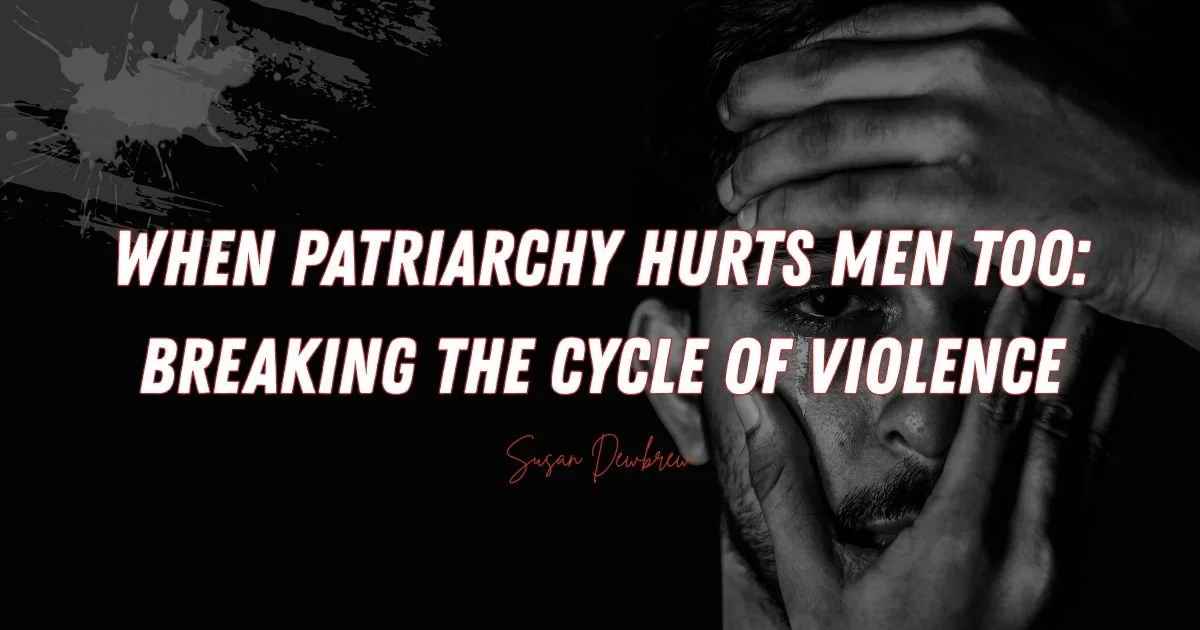
When Patriarchy Hurts Men Too: Breaking the Cycle of Violence
Every Father's Day, I notice something telling about how we celebrate masculinity in the church. Walk into any Christian bookstore around mid-June and you'll find the greeting cards and gifts: camouflage everything, hunting gear, tools, grilling accessories, and maybe some books about "biblical manhood" that usually involve conquering something.
What you won't find? Anything related to the actual work of fathering—diapers, baby bottles, children's books, or anything that acknowledges that being a dad involves the tender, nurturing care of small humans.
This disconnect reveals something profound about how patriarchal culture has wounded not just women, but men themselves. We've created a definition of masculinity so narrow and performance-based that it's literally killing the men we claim to honor.
The Statistics Don't Lie
If patriarchy truly worked for men, we'd expect to see flourishing male populations in cultures where men hold all the power. Instead, we see the opposite.
In countries with the most rigid patriarchal structures, men often have:
Lower life expectancy
Higher suicide rates
Higher rates of depression and anxiety
Increased likelihood of violence and incarceration
Greater social isolation and fewer deep friendships
Even in America, men are more likely to die by suicide than women, more likely to struggle with addiction, and less likely to seek help for mental health issues. The "strong, silent type" isn't just hurting women—it's literally killing men.
If the patriarchal system was truly God's design for male flourishing, wouldn't we expect to see healthier, happier men? Instead, we see men trapped in a performance-based identity that leaves them exhausted, isolated, and competing with each other for limited resources.
The Apple Fight Mentality
In our conversation on the podcast, I talked about this idea of "fighting for apples"—the mentality that sees all of life as a zero-sum game where there's only so much power, success, or value to go around. If you get some, that means there's less for me.
This scarcity mindset drives so much of the competition and violence we see between men. From the very beginning, we see this pattern in Scripture:
Cain and Abel: The first brothers in human history, and one murders the other out of jealousy and competition for God's favor.
Jacob and Esau: Twin brothers who spend decades in conflict over birthright and blessing.
Joseph and his brothers: Sibling rivalry so intense it leads to attempted murder and human trafficking.
David's sons: Amnon, Absalom, and Adonijah—their competition for succession tears the kingdom apart.
The pattern is consistent throughout Scripture: when men define their worth by external achievements and their position relative to other men, it leads to violence, betrayal, and broken relationships.
The Root of Violence
What I've come to understand is that patriarchal culture doesn't just give some men power over women—it creates a pyramid where only a few men have real power while most men are left fighting each other for scraps.
As Jess Hill observes in her book See What You Made Me Do, domestic violence often increases not when women are gaining power, but when men feel disempowered by other men—when they lose jobs, face financial stress, or feel unsuccessful compared to cultural expectations of male achievement.
Men who can't live up to society's narrow definition of masculinity often take out their frustration on those with even less power: women, children, and other vulnerable people. The violence isn't really about gender—it's about a system that tells men their worth depends on dominating others, then sets up most of them to fail.
This is why Paul's vision was so radical. He was offering men a completely different source of identity—not based on performance or dominance, but on being beloved sons of God.
Jesus in the Wilderness: A Different Model
The most powerful example of this different model comes from Jesus himself in the wilderness temptations. Satan's strategy is telling: "If you are the Son of God, turn these stones to bread" (Matthew 4:3, NIV). The temptation isn't just about hunger—it's about proving identity through performance.
But Jesus had just heard the Father say, "This is my Son, whom I love; with him I am well pleased" (Matthew 3:17, NIV). His identity was secure. He didn't need to perform to prove who he was.
"Man shall not live on bread alone, but on every word that comes from the mouth of God" (Matthew 4:4, NIV)—including that word of belovedness he'd just received at his baptism.
This is the key to breaking the cycle of violence and competition: men finding their identity in the Father's love rather than in external performance. When you know who you are, you don't have to fight others to prove it.
Redefining Biblical Masculinity
My husband Gregory embodies this different kind of masculinity. He's six feet tall with broad shoulders, raised in a rough area, and wouldn't hesitate to physically defend someone who needed protection. He's undeniably a "man's man" by any cultural definition.
But his strength has never once been used to intimidate me or get his own way. Never. Not physically, not financially, not emotionally. Instead, his power is channeled into service—he spent years feeding families in need and continues to use his strength to lift others up rather than keep them down.
This is what biblical masculinity actually looks like: strength in service of love, power used to protect and empower rather than control and dominate.
Yet somehow, our church culture has convinced men that changing diapers threatens their masculinity while threatening their wives enhances it. We've told them that emotional vulnerability is weakness while emotional abuse is leadership. We've created a system where men are afraid to show tenderness toward their own children for fear of appearing "soft."
The Prison System as Proof
If we want to see where the patriarchal model leads, we need only look at America's prison system. The vast majority of violent criminals are men who bought into our culture's definition of masculinity—men who believed that strength meant the ability to dominate others, that respect came through fear, and that their worth depended on being tougher than everyone around them.
These men aren't the beneficiaries of patriarchy—they're its victims. They've been sold a lie about what it means to be a man, and they're paying the price with their freedom, their families, and often their lives.
Meanwhile, the men who have learned to lead through service, to show strength through gentleness, and to find their identity in God's love rather than others' fear—these men have healthier relationships, deeper friendships, and more fulfilling lives.
Breaking the Cycle
The good news is that God's Kingdom offers a completely different model. In God's Kingdom:
Your identity comes from being loved by the Father, not from your performance
Leadership means service, not domination
Strength is measured by your capacity to love, not your ability to control
Success means lifting others up, not climbing over them
Provision comes from God's abundance, not from grabbing limited resources
When men embrace this Kingdom model, several things happen:
They stop competing and start collaborating. There's no need to fight for apples when you know the Father owns the orchard.
They become better fathers. When your masculinity isn't threatened by tenderness, you can fully engage in the nurturing work of raising children.
They develop deeper relationships. Emotional vulnerability becomes strength rather than weakness, allowing for authentic connection.
They find freedom from performance pressure. Your worth isn't tied to your achievements, so you can rest in God's love even during seasons of failure or struggle.
They become agents of healing rather than sources of harm. Instead of perpetuating cycles of violence and abuse, they break them.
A Call to Men
If you're a man reading this, I want you to know: the narrow, performance-based definition of masculinity that our culture promotes isn't helping you. It's hurting you. It's keeping you from the deep relationships, the authentic identity, and the meaningful purpose that God designed you for.
You don't have to prove your worth by dominating others. You don't have to compete with other men for limited resources. You don't have to hide your emotions or avoid the tender aspects of relationships to maintain your masculine credentials.
Your worth comes from being a beloved son of the Father. Your strength is meant to serve love, not fear. Your power is designed to lift others up, not keep them down.
The men who embody this Kingdom model aren't less masculine—they're more fully human. They're living out the original design that was interrupted by the fall and restored by Christ.
The Choice Before Us
We have a choice to make. We can continue promoting a model of masculinity that leads to competition, violence, and isolation. Or we can embrace the model that Jesus demonstrated—strength in service of love, power channeled toward healing and restoration, identity rooted in the Father's pleasure rather than worldly performance.
The statistics make it clear: the patriarchal model isn't working. It's not making men healthier, happier, or more whole. It's time to try something different.
It's time to embrace the masculinity that Jesus modeled—the kind that doesn't need to prove itself by diminishing others, the kind that finds its power in laying down its life, the kind that measures strength by the capacity to love.
This isn't about making men weaker. It's about making them stronger in the ways that actually matter—stronger in love, stronger in character, stronger in their ability to create life and healing rather than destruction and fear.
The world is desperately waiting for men who embody this different kind of strength. The question is: are we ready to answer that call?
Blessings,
Susan 😊