
You Can't Storm Mountains with Wounded Warriors
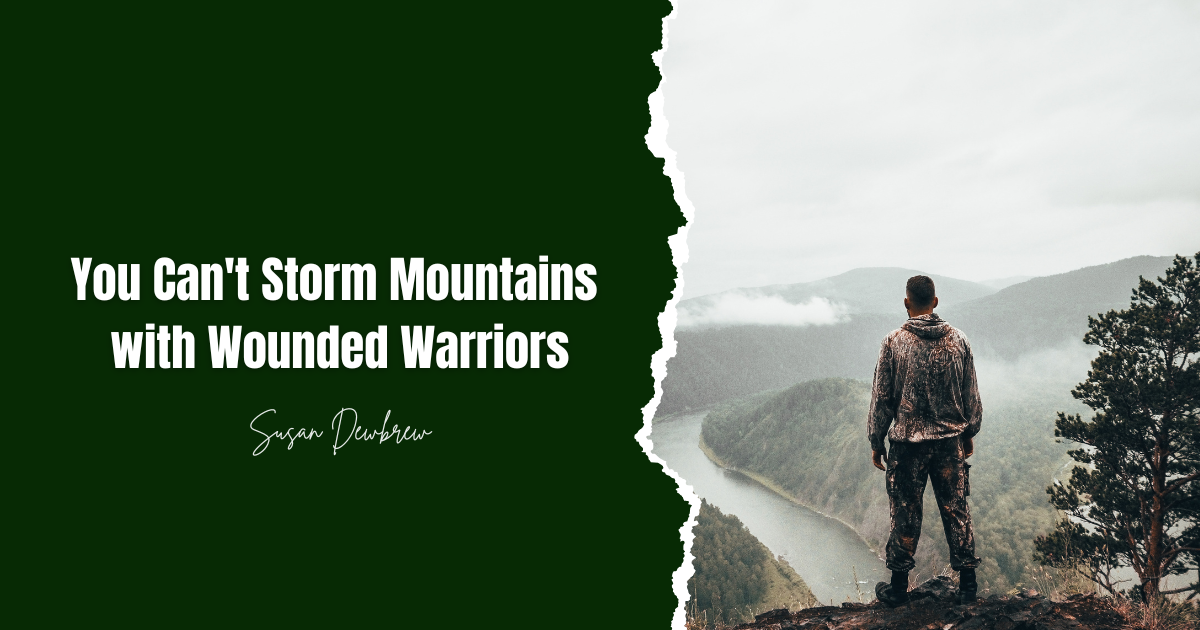
Picture this: Three disciples descend from a mountaintop where they've just witnessed Jesus transfigured in glory, conversing with Moses and Elijah, hearing the voice of God thunder from heaven. They're still processing what they've seen—Jesus radiating with the full glory of His divinity, a preview of resurrection power that death cannot touch.
Then they reach the bottom of the mountain and find chaos. A desperate father. A demon-possessed boy being thrown into fire and water. And their fellow disciples—unable to help.
This scene from Matthew 17 contains a truth most of us have missed: You cannot take the mountain until you've delivered the enslaved soul at its foot.
The Seven Mountains Movement Gets Half the Story Right
The teaching about taking the seven mountains of cultural influence—government, education, media, arts, business, family, and religion—has inspired many believers to see their workplaces and spheres of influence as mission fields. This is good! We absolutely should be advancing God's Kingdom in every realm of society.
But here's what we've missed: We're sending wounded warriors into battle.
We've focused so intently on strategies for cultural transformation that we've neglected the prerequisite work of personal transformation. We're asking people to charge mountains while they're still being cast into the fire by their own inner demons—unhealed wounds, false beliefs about themselves and God, patterns of fear and shame that keep them enslaved.
Jesus shows us a different pattern in Matthew 17. Before His disciples could move that mountain (and He promised they could move Mount Hermon itself!), they had to learn how to minister to the hurting individual right in front of them.
Why Couldn't We Cast It Out?
The disciples' question reveals something profound: "Why couldn't we cast out this demon?" (Matthew 17:19, NKJV).
Jesus' answer cuts to the heart: "Because of your little faith. For assuredly, I say to you, if you have faith as a mustard seed, you will say to this mountain, 'Move from here to there,' and it will move; and nothing will be impossible for you" (Matthew 17:20, NKJV).
Wait—that sounds contradictory. You couldn't cast it out because of little faith, but if you had a little faith (even mustard-seed sized), you could move mountains?
Here's what Jesus was saying: The problem wasn't the size of their faith but the focus of it.
They were too busy evaluating their own faith, trying to muster up enough spiritual power, wondering if they had what it took. They were self-focused rather than other-focused. They were operating from a subtle fear of failure rather than from love for this suffering family.
Faith works by love. Love is outward-focused. When we fixate on our own performance, our own spiritual résumé, our own success or failure in ministry, we're still caught in the very fear-system Jesus came to dismantle.
The Real Battle: Fear of Death, Not Sin Management
This brings us to the core issue that makes inner healing so essential: Most Christians have been taught that sin is the primary problem, but Scripture reveals something deeper.
Hebrews 2:14-15 (NKJV) says that Jesus became human "that through death He might destroy him who had the power of death, that is, the devil, and release those who through fear of death were all their lifetime subject to bondage."
Read that again. The real slavery isn't to sin directly—it's to the fear of death. And that fear isn't just about physical mortality. It's the fear of:
Psychological death (rejection, abandonment)
Social death (shame, insignificance)
Relational death (being unloved, unseen, unvalued)
We're all born mortal with a self-preservation instinct wired into us. That instinct, when disconnected from secure love, becomes selfishness. Selfishness manifests as sin. But sin is the symptom, not the root disease.
This is why the law, as good and holy as it is, actually strengthens sin rather than defeating it. The law points out the symptom but cannot cure the disease. It's like receiving a cancer diagnosis without treatment—now you know you're dying, but you can't do anything about it. In fact, awareness without power just intensifies the fear.
The Ekklesia's True Work: Grassroots Transformation
So what does this mean for the Ekklesia—God's governmental assembly?
The Ekklesia isn't just about strategic planning sessions where we plot how to influence culture. It's not primarily about mobilizing believers for political action or marketplace ministry (though those can be expressions of it).
The Ekklesia's first work is priestly, prophetic, and kingly ministry to individuals—bringing healing, deliverance, and restored identity.
Here's what that looks like practically:
Priestly Ministry: Creating atmospheres of worship where God's glory flows and people encounter His love directly. In that environment, shame begins to lift. The fear of rejection melts in the presence of perfect love.
Prophetic Ministry: Hearing from God about the lies people believe, the wounds they carry, the places where death has locked them up. This isn't fortune-telling—it's revelation that brings healing.
Kingly Ministry: Taking what we've heard in the heavenly council and enacting it on earth. This is where we cut keys to unlock gates of death. We create strategies for freedom. We activate people into their callings.
But notice the order: We start with the individual heart. We minister to the person being thrown into the fire. We bring deliverance before we march toward dominion.
You Can't Defeat Rome Using Roman Tools
Here's a principle that transforms everything: You cannot defeat the world's system of dominance and control by using its own methods.
The kingdoms of this world operate through force, manipulation, coercion, and fear. They demand compliance. They use shame to control. They create hierarchies where some have power over others.
God's Kingdom works completely differently. Power flows through love, not force. Authority means responsibility to serve, not privilege to control. Leadership means lifting others up, not climbing over them.
When we try to transform culture through the world's methods—political coercion, shame-based messaging, us-versus-them tribalism, fear-mongering—we're just replacing one Babylon with another.
Real transformation happens from the grassroots up. It happens through healed hearts that naturally produce healthy communities. Those communities then organically influence the mountains of culture.
We take the mountains by coming down and focusing on individual hearts. Those hearts become like roots that join together in communities. And from that soil, Kingdom life grows up and transforms the mountains from the bottom up.
It's the parable of the leaven all over again. The Kingdom doesn't come through forceful conquest. It comes through organic, relational, love-powered transformation that permeates every level of society.
The Strategy Isn't to Rail at Mountains
So often I see Christians railing against the darkness in government, media, education, business. We post angry rants on social media about how corrupt the system is. We complain about the wickedness on the mountain.
But here's what I've learned: The strategy isn't to rail at the mountains. It's to love the individuals who compose them.
Every person in government, media, education, or any other sphere is someone God loves. Every person on that mountain is someone who might be enslaved to fear, carrying wounds, believing lies about themselves and God.
What if instead of seeing them as enemies to defeat, we saw them as enslaved souls who need deliverance?
What if our approach to cultural transformation started with compassion?
This doesn't mean we ignore injustice or refuse to speak truth. Jesus certainly didn't. But it does mean our motivation shifts from anger and fear to love and hope.
When immigration debates rage, do we see immigrants as political pawns or as human beings God loves? When we disagree with someone's lifestyle or politics, do we see an enemy or an enslaved soul who needs freedom?
Practical Steps: Inner Healing as Kingdom Work
So how do we make inner healing central to our Ekklesia gatherings and Kingdom work?
1. Create Safe Spaces for Vulnerability
People can't heal from wounds they're afraid to reveal. The Ekklesia must be a place where it's safe to not be okay, where weakness is welcomed, where we can speak our pain without shame.
2. Learn to Listen Prophetically
This means asking Holy Spirit, "What's really going on here? What lie is this person believing? What wound is driving this behavior?" Then speaking truth in love.
3. Minister Deliverance Alongside Healing
Sometimes people need demons cast out. Sometimes they need false beliefs exposed and replaced with truth. Often they need both. Don't separate deliverance from discipleship.
4. Address Fear of Death in All Its Forms
Help people identify where fear—not just sin—is driving their choices. Where are they operating from self-preservation? Where has rejection shaped their identity? Where does shame keep them hidden?
5. Point People to Their True Identity
The ultimate healing comes from knowing whose we are: "This is my beloved child in whom I am well pleased." That truth, internalized and believed, transforms everything.
6. Release People into Their Callings
Once people are being healed and delivered, activate them! Don't keep them dependent on ministry. Launch them into their own spheres of influence as healed healers.
The Vision: Healed Warriors Taking Territory
Imagine what could happen if the Church truly embraced this priority.
Imagine believers entering their workplaces not as wounded people trying to hold it together, but as whole people overflowing with love.
Imagine parents raising children from healed hearts rather than passing down generational wounds.
Imagine government officials, educators, artists, and business leaders operating from security in God's love rather than from fear, ambition, or the need to prove themselves.
That's when we'll see mountains move.
Not through strategic programs alone, but through transformed people naturally releasing God's Kingdom wherever they go.
The boy at the foot of the mountain in Matthew 17 couldn't wait for his deliverance until after the disciples took the mountain. He needed freedom now. And his freedom was actually the pathway to moving the mountain.
The same is true today. The enslaved souls all around us can't wait for us to fix the culture before we minister to them. They need deliverance now. And their deliverance—multiplied across thousands and millions of lives—will be what actually transforms the culture.
The Call
So here's my challenge: Before you create another strategy for influencing your mountain of culture, ask yourself:
Who is the suffering individual right in front of me?
What inner healing work have I neglected in my own life?
Is my Ekklesia (whether that's two people in a break room or two hundred in a building) prioritizing inner healing?
Am I operating from love or from fear?
Am I focused on my own performance or on compassion for others?
The work of the Ekklesia isn't just governmental—it's deeply pastoral and healing-focused. We can't separate dominion from deliverance. We can't take territory while leaving casualties behind.
The Kingdom of God has come. It is coming. And it will come—through healed hearts releasing love wherever they go.
That's how we move mountains.
Blessings,
Susan 😊
What's your experience? Have you seen the power of inner healing to prepare people for Kingdom influence? Or have you experienced the burnout of trying to take territory while still carrying wounds? I'd love to hear your thoughts in the comments below.