
Hair Length, Head Coverings, and the Art of Missing Paul's Point
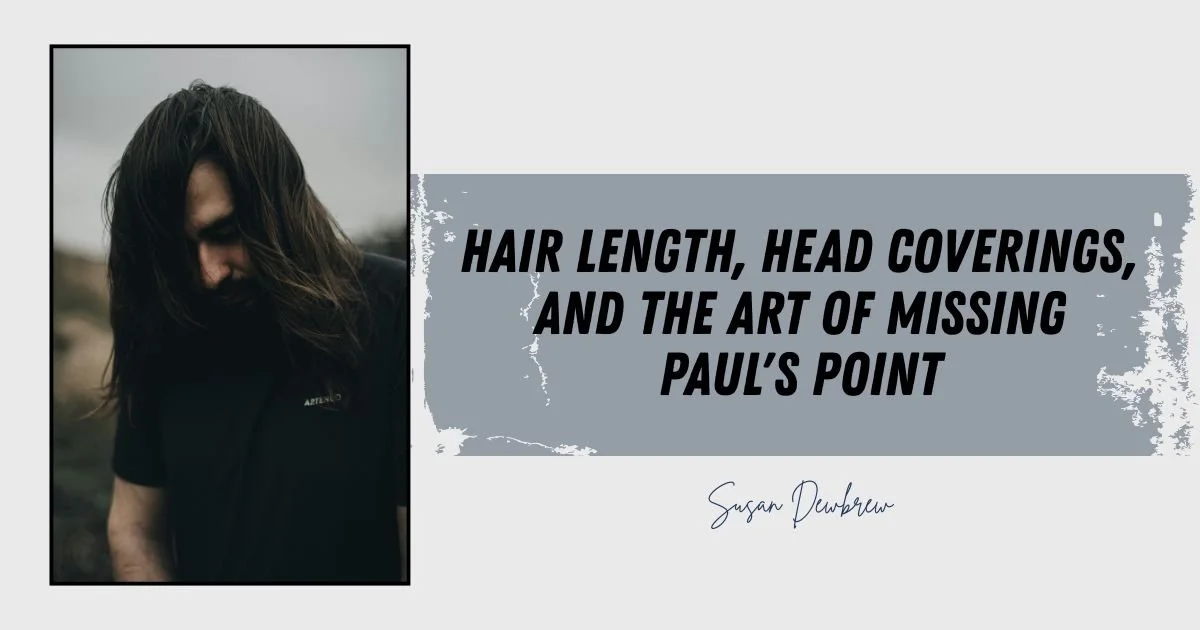
"Doesn't nature itself teach you that if a man has long hair it is a disgrace to him?" (1 Corinthians 11:14, NKJV).
Okay, let's be honest: Does nature teach us that?
Left to nature, a man's hair grows just as long as a woman's. Male lions have longer, more prominent hair than females. Throughout nature, males are often more vibrant, more decorated than females.
So no, nature doesn't teach us that men should have short hair.
Yet for years, I believed—truly believed—that this passage was establishing a divine law about hair length. Women couldn't cut their hair. Men had to keep theirs short. It was so clear to me that I couldn't understand how anyone could read it differently.
Until I actually studied it. And when I did, everything I thought I knew fell apart.
The Divine Order That Doesn't Make Sense
First Corinthians 11 is often taught as establishing a "chain of command": God over Christ, Christ over man, man over woman. This hierarchy is supposedly shown through head coverings and hair length.
But let's think about that for a moment. If this is about hierarchy, why is God over Christ? Isn't Christ God? How can there be a hierarchy within the Trinity? That makes the whole "divine order" argument fall apart immediately.
And if men are supposed to have short hair to show they're under authority, what about the Nazarite vow? In Deuteronomy, God Himself prescribed that those setting themselves apart for Him should not cut their hair (Numbers 6:5, NKJV).
If a man followed this biblical command to let his hair grow as a sign of devotion, wouldn't he be violating what Paul supposedly teaches here? It's a contradiction—unless Paul isn't making a universal law about hair length at all.
What About Jesus?
And speaking of the Nazarite vow, what about Jesus Himself? Based on historical evidence like the Shroud of Turin and cultural norms of the time, Jesus likely had shoulder-length hair—maybe longer.
Was that "short enough"? If we're going to make hair length a law, exactly how short is short enough? Who decides?
The whole premise becomes absurd when you try to apply it consistently.
The Symbol of Authority on Her Head
Then there's verse 10: Women should have "a symbol of authority on her head because of the angels" (1 Corinthians 11:10, paraphrased).
Wait—we have to dress for angels? We need to show them we're under someone's authority?
This interpretation makes women's head coverings about submission to male authority. But is that really what Paul is saying?
And if it is, why aren't churches practicing it? If this is a timeless command, why do we ignore it? Why aren't women wearing physical head coverings in church today?
The Pattern Repeats
Here's what's fascinating: First Corinthians 11 follows the same pattern as chapter 14 (the "women be silent" passage). Paul appears to be dealing with what the Corinthians wrote to him—their rules, their confusion, their false teachings.
Remember 1 Corinthians 7:1: "Now concerning the things you wrote to me..." (NKJV). That launches a series of topics where Paul quotes their positions and then responds.
In chapter 11, Paul seems to be addressing their obsession with head coverings and hair length—cultural issues that the Corinthians were turning into spiritual laws.
The Conclusion Everyone Misses
Here's the kicker: After all the discussion about hair length and head coverings, Paul concludes in verse 16: "But if anyone seems to be contentious, we have no such custom, nor do the churches of God" (1 Corinthians 11:16, NKJV).
Wait... what?
"We have no such practice"?
It's like Paul saying: "You guys are doing A, B, and C. Here's why your reasoning doesn't make sense... But by the way, we don't even do A, B, and C!"
He's not establishing laws about hair and head coverings. He's dismantling the Corinthians' false teaching about them!
Why We Twist Ourselves in Knots
I used to twist this passage into pretzels trying to make it work:
"Well, it's not a law exactly, but it's still wisdom..." "It's about the principle, not the actual practice..." "It's cultural, but the spiritual truth behind it is timeless..."
We do this because we can't admit that we might be misreading it. We've been taught it means one thing, and challenging that interpretation feels like challenging Scripture itself.
But good hermeneutics—good interpretation—requires us to look at context. To understand culture. To see patterns. To admit when something doesn't make logical sense.
The Real Point
So what is Paul actually teaching in 1 Corinthians 11?
He's addressing a church that's trying to create new laws about appearance, about who can participate based on cultural customs, about hierarchy and authority expressed through clothing and grooming.
And Paul says: No. We don't do that.
The early church wasn't about external markers of status or submission. It was about mutual participation, spiritual gifts flowing freely, the body functioning together.
When we make 1 Corinthians 11 about establishing male authority over women, we miss the point entirely. Just like when we made it about hair length, we missed the point.
The Invitation
If you've been taught that 1 Corinthians 11 establishes male authority over women through head coverings or hair length, I invite you to look again.
Look at:
The actual conclusion Paul draws in verse 16
The cultural context of Corinth
The pattern of Paul addressing their false teachings throughout the letter
The contradiction with the Nazarite vow and Jesus' own appearance
Whether "nature" really teaches what this passage claims
And ask yourself: Are we practicing what we claim this passage teaches? If not, why not? And if we're not practicing it because it's cultural, why do we still use it to enforce hierarchy?
Maybe—just maybe—Paul's point was never about hair or coverings or hierarchy at all. Maybe it was about freedom from these kinds of external, cultural markers of status.
Maybe the church was always meant to be a place where "there is neither Jew nor Greek, there is neither slave nor free, there is neither male nor female; for you are all one in Christ Jesus" (Galatians 3:28, NKJV).
Have you struggled with this passage? What's your experience with teachings about hair length or head coverings? Share your story in the comments—your journey matters.
Blessings,
Susan 😊