
The 1950s Mirage: Why 'Back to the Way Things Were' Won't Save Our Families
There's a common thread running through many of the critical responses to egalitarian teaching: fear. Deep, visceral fear about what's happening to families, to children, to society.
I understand that fear. As a parent and grandparent, I know what it's like to look at our culture and feel that rising sense of panic. What's happening to marriage? What are our kids being taught? What values are they absorbing?
And in that fear, many people look backward with nostalgia. If we could just get back to the 1950s, to Leave It to Beaver and Ozzie and Harriet, when families were intact, gender roles were clear, and everyone knew their place...
But here's the uncomfortable truth: That world was a mirage. And it's not just that it wasn't perfect—it's that it was the very foundation of what came after.
The Facade That Cracked
The post-World War II generation desperately wanted normalcy. They'd been through Depression and war. They wanted peace, prosperity, suburbs, two-car garages, and the American Dream.
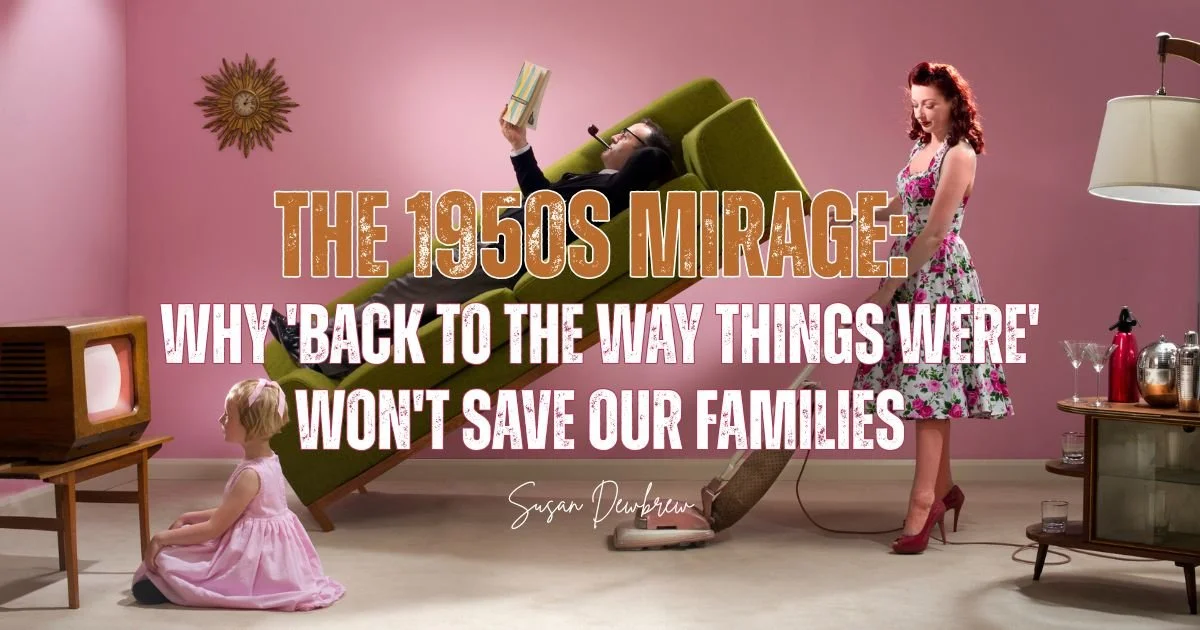
So they created it. Or rather, they created the image of it. White picket fences. Dad going to work. Mom in pearls vacuuming. Kids playing in the yard. Everything picture-perfect.
But underneath that veneer was something hollow. The Father Knows Best image covered up deep dysfunction, silenced abuse, suppressed authentic emotion, and enforced rigid roles that many people couldn't actually inhabit.
And what happened? The pressure built. The resentment grew. The hypocrisy became unbearable.
The 1950s didn't protect the family—they produced the explosive rebellion of the 1960s and 70s. The very generation that was supposed to be saved by those "traditional family values" rejected them wholesale.
What We're Really Trying to Conserve
Many people who identify as conservative—politically and religiously—are trying to conserve something. But what exactly?
That false memory. That nostalgic ideal of "the way things used to be." That fantasy of order and clarity where everyone knew their role and things just... worked.
But it never really worked. Not for the women who were trapped in abusive marriages with no recourse. Not for the children who were taught that image management mattered more than authenticity. Not for the men who couldn't express emotion or vulnerability without being shamed.
Every generation tends to romanticize the past and panic about the future. "Kids these days don't know..." But the truth is, the "good old days" weren't as good as we remember. And they certainly aren't the solution to today's problems.
The Real Threat to Family
So what actually threatens healthy families? Not equality. Not mutual submission. Not women having a voice.
The real threat is fake families. Families that look perfect at church but are ruled by intimidation at home. Families where children are walking on eggshells, afraid to crack one and make the "powerful one" angry. Families where abuse is hidden behind a veneer of biblical submission.
That's what destroys families. That's what sends kids running from faith as soon as they're old enough to escape.
My heart is absolutely pro-family. I believe healthy families are key to unleashing God's Kingdom. But a false family—where everyone pretends everything is fine while violence, control, or emotional abuse happens behind closed doors—that needs to stop.
The madness has to stop.
What Actually Creates Healthy Families
Here's what I've learned: Healthy families aren't built on hierarchy. They're built on love. Real love—the kind that casts out fear.
Perfect love cannot exist without freedom. Think about it: In the garden, God risked everything for love to win. He gave Adam and Eve freedom—real freedom—because without it, there can be no authentic love.
Most people react to that idea with fear: "But if we give people freedom, their sinful nature will run amok! It'll be chaos! Anarchy!"
And yes, when hearts are deceitful, that's a risk. There are people whose hearts are bent toward destruction, and they create havoc. They're the weeds among the wheat.
But most people, when given freedom in the right context—when connected to the One who loves them, when they know they have everything they need in Christ—they choose well.
My heart doesn't long to steal from anybody. My heart doesn't want to cheat on my husband. My heart doesn't want to lie. As a kid, I did those things. I stole. I lied. But I'm not that person anymore. I've matured past that.
I don't need a law telling me not to steal. I don't need a law telling me to be true to my husband. My heart longs to be true to Gregory. My freedom is exercised in love because I'm confident in love.
Fear vs. Love
The fear driving so much of the reaction to egalitarian teaching is understandable. But fear is never the answer.
"Perfect love casts out fear" (1 John 4:18, NKJV). Not rules. Not hierarchy. Not control. Love.
And love requires freedom. You can't force someone to love you. You can demand submission, but that's not love—that's compliance. You can impose authority, but that's not relationship—that's domination.
When we create systems where one person must always submit to another, where one person holds all the authority and the other has none, we don't create love. We create fear. We create resentment. We create the very problems we're trying to prevent.
The Church's Role
The church's heart has often been pro-family, and I'm grateful for that. My heart is pro-healthy marriage, pro-healthy families. I believe it's absolutely key to unleashing God's Kingdom.
But here's what has to happen:
First, we have to tell the truth. We have to say that abuse is wrong—not suffering for Jesus, not biblical submission, but sin. Period. People need to know that what's happening in their homes isn't normal, isn't godly, isn't something they have to tolerate.
Second, we have to create safe places. Churches need to be trauma-informed enough, safe enough, that people can share what's really happening. Where we won't throw stones at the family, but we will step in and help create healthy patterns.
Third, we have to require change from abusers. If one person is unwilling to face their own wounds—the wounds creating dysfunctional patterns—maybe they don't get to stay. Not until they're willing to do the work of genuine transformation.
This isn't about divorce. It's about accountability. It's about saying that we value the vulnerable more than we value keeping up appearances.
What Hierarchy Actually Produces
Those who teach hierarchical family structures need to face what their theology produces. I say this not to be harsh, but because I've had to face it myself.
I had to look at what my complementarian beliefs were creating:
Women trapped in abusive situations
Children traumatized by what they witnessed
Gifts suppressed and voices silenced
People leaving the faith because "biblical" marriage was destroying them
I didn't like what I saw. I had to walk out of it. And I'm inviting others to do the same—not with condemnation, but with compassion, because I know how hard it is.
When we enforce rigid gender roles and male authority, we often see:
Power being abused by those who believe they have a right to it
Resentment building in those forced to submit
Children confused about healthy relationships
Dysfunction being baptized as "biblical"
The Vision for Something Better
But there's good news: Another way is possible.
Marriages built on mutual submission, where both partners defer to each other, where leadership is fluid based on wisdom and gifting, where love is the foundation—these marriages thrive.
Families where children see parents honoring each other, where decisions are made together, where no one is walking on eggshells—these families produce spiritually and emotionally healthy kids.
Churches that empower both men and women, that refuse to tolerate abuse, that care more about wholeness than appearances—these churches transform communities.
This isn't a fantasy. It's reality for those of us living in God's Kingdom way. And it's available to anyone willing to exchange fear for love, control for freedom, hierarchy for mutual honor.
The Increase of His Kingdom
Isaiah prophesied: "Of the increase of His government and peace there will be no end" (Isaiah 9:7, NKJV).
God's Kingdom is growing. Shalom is breaking out in the world. We're not in decline—we're moving toward the fullness of Christ's reign.
But we have to let go of the false securities we've clung to. The nostalgia for a past that never really existed. The belief that control and hierarchy will protect us.
Fear whispers: "Hold on tighter. Enforce the rules. Get back to tradition."
But Love says: "I've got this. Trust me. Walk in freedom. Build on my foundation of mutual honor and service."
An Invitation
If you're afraid—afraid of what's happening to families, to children, to society—I get it. That fear is real.
But I invite you to bring that fear to the only One who can heal it. To perfect Love who casts out fear.
Ask Holy Spirit: "What are you really asking of me? What does Kingdom family look like?"
You might be surprised to find it doesn't look like the 1950s. It looks like the Kingdom Jesus inaugurated—where the first are last and the last are first, where leaders serve and servants lead, where love is the fulfilling of the law.
The way forward isn't backward. It's upward and inward—into the heart of God where perfect love dwells.
And from that place of love, without fear, we can build families that truly reflect His nature. Families where everyone can flourish. Where authenticity replaces image management. Where mutual submission creates the safety for authentic intimacy.
This is the Kingdom way. And it's been here all along, hidden in plain sight, waiting for us to have the courage to embrace it.
What's your experience? Have you seen the difference between hierarchy-based families and love-based families? How has fear or freedom shaped your relationships? Share your thoughts in the comments.
Blessings,
Susan 😊