
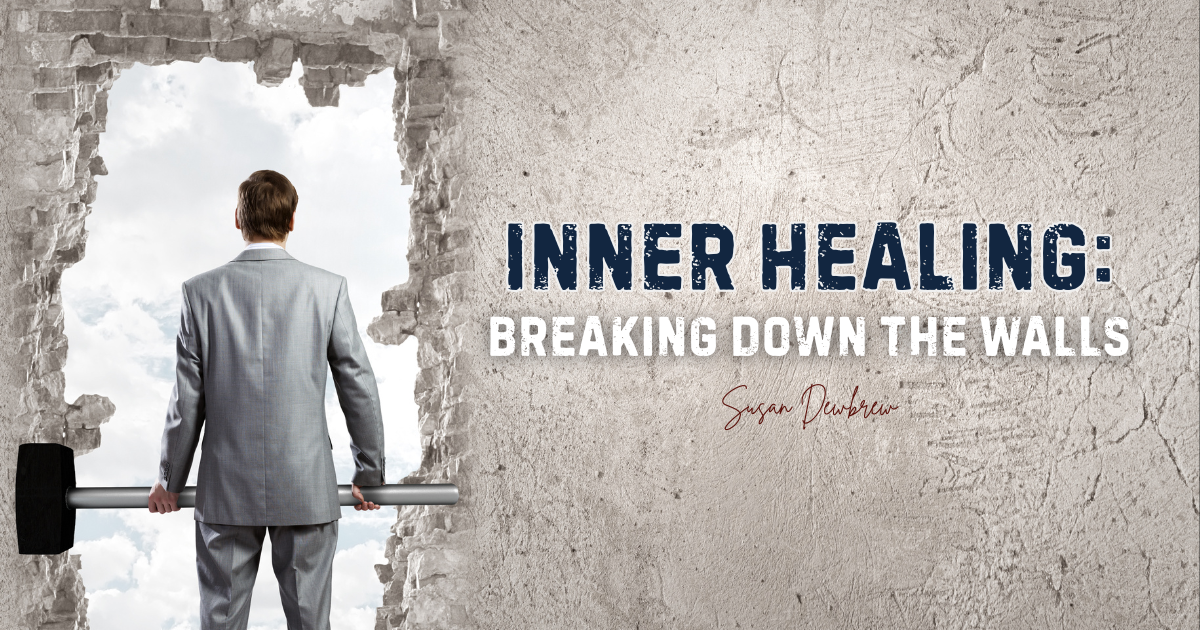
Inner Healing: Breaking Down the Walls
I need to be honest with you about something I'm still working through: comfort eating.
There are times when I don't even realize I'm doing it. I'll find myself in the kitchen, reaching for food when I'm not actually hungry. And for years, I couldn't figure out the pattern. Why was I doing this? What was triggering it?
Then God began to show me: I was doing it when I felt lonely. Even when I was surrounded by people. Because when I'm not feeling connected enough, or when I'm withholding myself because I'm afraid—afraid I'm not enough, afraid that if people really saw me they wouldn't like what they see—I self-soothe.
Food became my friend when I was a little girl and was left alone a lot. And decades later, that coping mechanism was still running in the background.
Some issues God heals in a moment. Others unfold over time. And I'm learning to trust Him in both. To trust that He loves me in the midst of the journey, not just at the destination. That I don't have to beat myself up for not having "arrived" yet.
Because beating myself up only makes me feel inadequate, which makes me want to comfort eat, which creates a circular pattern of pain.
Why Inner Healing Matters for the Kingdom
Before we dive into the how of inner healing, I want you to understand why it matters—not just for you personally, but for the Kingdom of God.
Remember Joshua and Caleb? They were ready to enter the Promised Land. They had faith. They weren't afraid of the giants. But they didn't get to go in for forty years. Why? Because this is a team sport.
God's people operate as a body, not just as individuals. My individual healing isn't just about me. It's about what I bring—or fail to bring—to the collective mission.
If I show up to the ecclesia still operating out of unhealed trauma, I'm going to be:
Greedy for validation and attention
Selfish with resources
Immature in how I handle conflict
Easily offended and quick to take things personally
Judgmental toward others
Slow to extend grace and love
I might be sincere. I might be passionate about the Kingdom. But I'll be a liability rather than an asset because I'm bringing toxicity instead of health.
The ecclesia—God's governing assembly—can only function effectively when enough of us are healthy enough to bring health. When we've dealt with our own stuff enough that we can focus on loving others rather than constantly needing others to validate us.
This is why inner healing isn't optional. This is why we can't just focus on "out there" transformation while ignoring "in here" transformation.
What Hardness of Heart Really Is
When the book of Hebrews talks about Israel's failure to enter the Promised Land "because of the hardness of their hearts" (Hebrews 3:8-11, paraphrased), it's easy to hear that as condemnation. As if God is saying, "You wicked, wicked people with your hard hearts!"
But I don't think that's what's happening at all.
Hardness of heart isn't primarily about wickedness. It's about self-protection.
When we've been hurt, traumatized, rejected, or abandoned, we build walls around our hearts. We toughen up. We develop a shell to hide behind. We harden ourselves so we won't be as vulnerable to future pain.
This feels like survival. And in some seasons, maybe it is survival. But what starts as a temporary protective measure often becomes a permanent prison.
The walls we build to keep pain out also keep love from getting in. They keep truth from penetrating. They keep us from being fully seen and fully known—which means they keep us from experiencing the kind of intimacy with God and others that we were created for.
The Lies We Believe
At the root of most of our self-protective walls are lies we've believed about ourselves and about God.
"I'm not enough." "God won't protect me, so I have to protect myself." "If people really knew me, they wouldn't love me." "I'm damaged goods." "I'm too broken to be used by God." "God is disappointed in me." "I have to perform to earn love and acceptance."
These lies don't usually announce themselves clearly. They run in the background of our lives, shaping our behavior, driving our choices, creating patterns we don't even recognize.
Until God begins to expose them.
My Story: The Lie About My Father
When I was three or four years old, my father left. And somewhere in my little-girl heart, I came to believe it was my fault. If I had been a better girl, if I had been good enough, he wouldn't have left.
That lie created in me a performance-oriented drive that operated in the background for decades. I didn't even know it was there. I just knew I always felt like I had to work harder, do more, be better. I would stay up all night working on projects because somehow, in my subconscious, I believed that if things weren't perfect, people would leave.
Then, in a healing session similar to what I'm about to walk you through, God showed me that memory. He showed me the lie I'd believed. And He gave me the truth: it wasn't my fault. My father's leaving had nothing to do with whether I was a "good little girl." I was a child, and adult decisions weren't my responsibility.
When I came out of agreement with that lie and into agreement with the truth, something shifted. The lie no longer had the same power over me. I still had decades of neural pathways—habitual ways of thinking—but now I was aware of them. When performance thoughts would arise, I could recognize them: "Oh, that's based on the lie. I don't need to think that way. I don't need to strive like that. I'm okay. People aren't going to leave if I'm not perfect."
And over time, new neural pathways formed. New ways of thinking. New patterns of behavior.
That's the power of coming out of agreement with lies and into agreement with truth.
The Process of Inner Healing
So how do we actually do this? How do we let God into the painful places and allow Him to heal what's broken?
Let me walk you through a process that has been transformative for me and for many others. This isn't a magic formula—it's simply a way of creating space for God to speak truth into our hearts.
Step 1: Ask God to Show You Where the Lie Took Root
Find a quiet place where you won't be interrupted. If you're driving, please pull over. If you're in the middle of something, pause and come back when you can give this your full attention.
Then invite God in: "Father, I want You to show me a memory or a moment when a lie took root in my heart. When did I first believe I had to protect myself? That I couldn't trust You? That I wasn't enough?"
Wait. Be still. Don't force it. Whatever memory or image comes to mind, don't second-guess it. Even if you think you might be making it up, trust that God can meet you even in your reasoning and logic.
Step 2: Note the Details
When you have a memory or image, pay attention to the details:
How old are you?
Where are you?
Who else is there?
What's happening?
Ask God to draw your attention to anything significant about that moment—about the room, about the person, about the circumstances.
Step 3: Identify the Lies You Believed
Now ask two questions:
"Lord, what lie did I believe about myself in that moment?"
Maybe it was:
"I'm not lovable"
"I'm not safe"
"I have to earn acceptance"
"I'm a burden"
"I'm worthless"
"Lord, what lie did I believe about You in that moment?"
Maybe it was:
"God wasn't there"
"God doesn't care"
"God allowed this to happen because I deserved it"
"God is angry with me"
Don't rush this. Let Holy Spirit speak to you. The lies might come as words, or as a feeling, or as a knowing.
Step 4: Ask God Where He Was
This is crucial: "Lord, where were You in that moment?"
God was there. He didn't abandon you. But in our pain, we often couldn't see Him or feel Him. Now, with the perspective of time and healing, ask Him to show you where He was.
Sometimes people see Jesus standing nearby, grieving with them. Sometimes they sense His presence holding them. Sometimes they realize He was taking the brunt of the pain with them.
The truth is, He never left. But we need to know that in our hearts, not just our heads.
Step 5: Receive the Truth
Ask God to tell you:
"What is the truth about me? How do You see me?"
Wait for His words. They might be:
"You are loved"
"You are Mine"
"You are precious to Me"
"You are enough"
"You are powerful"
"You are called and equipped"
"What is the truth about You that I didn't know in that moment?"
Maybe:
"I was there with you"
"I wept with you"
"I've never stopped loving you"
"I'm strong enough to protect you"
"I'm good, even when people aren't"
Step 6: Come Out of Agreement with the Lies
Now, speak it out loud if you're able:
"I come out of agreement with the lie that [name the specific lie]. I come out of agreement with the lie that [name the lie about God]."
This is an act of your will. You're breaking the power of those lies by deliberately rejecting them.
Step 7: Come Into Agreement with the Truth
Then declare:
"I come into agreement with the truth that [name the truth God showed you about yourself]. I come into agreement with the truth that [name the truth about God]."
This might not feel completely true yet. That's okay. You're planting a seed of truth. God is going to take that seed and bury it in the good soil of your heart, and it will grow.
What Happens Next
Here's what I've experienced, and what I've seen in others:
The lie loses its power. It might still whisper, but now you recognize it as a lie. You have the truth to counter it with.
Old thought patterns start to shift. You become aware of when you're operating out of the old lies, and you can choose differently. Over time, new neural pathways form. New ways of thinking and behaving become natural.
Walls come down. You become more open, more vulnerable, more authentic. And that's when real community becomes possible. That's when you can truly connect with God and with others.
You bring health instead of toxicity to relationships. Because you're not constantly looking to others to fill the holes in your heart, you can actually love them freely.
It's a Journey
Some of you just did this exercise and experienced instant breakthrough. The lie is broken, the truth is established, and you feel free in a way you haven't felt in years or maybe ever.
Others of you are in a longer journey, like I am with the comfort eating. You've had some revelations, but there are still layers. Still patterns that keep showing up.
Both are normal. Both are okay. God loves you in both places.
Don't beat yourself up for not having "arrived." Don't shame yourself for still struggling. That shame just creates more pain to self-soothe, which perpetuates the cycle.
Instead, trust God in the journey. Trust that He's kind enough to meet you where you are. Trust that transformation is happening even when you can't see it clearly yet.
And keep showing up. Keep inviting Him in. Keep bringing your brokenness to the One who specializes in healing broken things.
Why This Matters for the Ecclesia
Here's why all of this matters beyond just your personal healing:
Church, as we've structured it, keeps us hidden. The clergy/laity separation means there are professionals who do ministry while the rest of us watch and maybe help around the edges. We sit in pews or rows of chairs, sing songs, hear a message, and go home—all without ever being truly seen or known.
We think that's safety. But it's actually isolation.
The ecclesia Jesus is building requires us to show up authentically. To be known. To bring our gifts and our healing to the table so the whole body can function as it's meant to.
But we can't do that if we're still operating out of unhealed trauma. We can't be vulnerable if we're terrified of rejection. We can't serve others well if we're desperate for validation. We can't bring health if we're still toxic.
So we must give ourselves permission to do this work. To say, "I'm going to assess how I really am—truthfully. I'm going to invite God into my pain. I'm going to let Him heal what's broken so I can be who He's called me to be."
Not alone. This work happens best in community, with safe people who can speak truth into your life, who can pray with you, who can help you see what you might be missing.
But it starts with you saying yes. Yes to the journey. Yes to vulnerability with God. Yes to taking down the walls.
The Invitation
God is inviting you into freedom today. Freedom from the lies. Freedom from the walls. Freedom from the fear that has held you captive.
He's not standing over you with condemnation, saying, "Why aren't you healed yet?" He's kneeling beside you with compassion, saying, "Let me into this painful place. Let me show you the truth. Let me set you free."
The hardened shell that's been protecting you is breaking. You don't need it anymore. Because perfect love casts out fear (1 John 4:18, NKJV).
His love is perfect. His love is strong enough. His love can be trusted.
So let the walls come down. Let your heart become tender again—not weak, but tender. Soft enough to receive His truth, His love, His healing.
Because healed people heal people. And the world is desperately in need of healed people.
The Kingdom of God is within you (Luke 17:21, KJV). And as the Kingdom works through you and throughout you, it goes out into the world wherever you have influence.
This is how the Kingdom actually comes. Through healed hearts. Through people who have allowed God to deliver them from fear and shame and lies, and who can therefore carry freedom to others.
You are free. You are loved. You are powerful. You are called.
Now go be who you are.
Blessings,
Susan 😊