
The Introduction Dilemma: Why Big Messages Need Small Doors
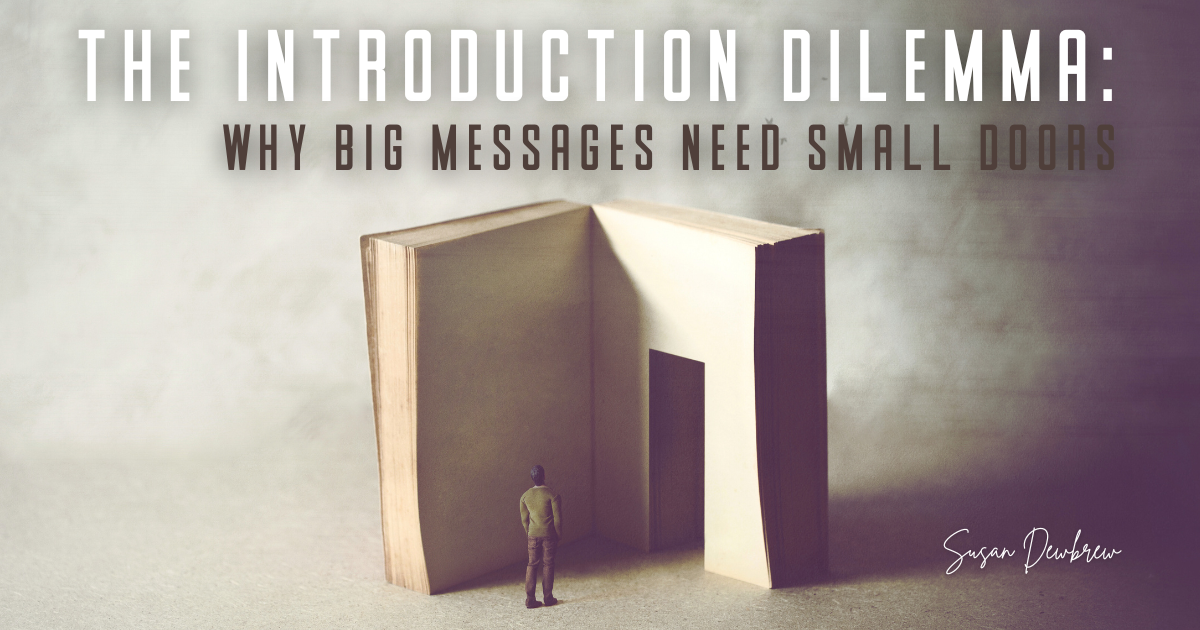
Have you ever tried to hand someone three thick books and say, "Here, read these—they'll revolutionize your understanding of Scripture"? I have. The response is predictably polite: "Thank you so much," followed by those books joining a stack somewhere, never to be opened.
This is the challenge we face when God reveals profound truths that challenge centuries of interpretation. How do you make revolutionary biblical revelation accessible without dumbing it down? How do you manage what I call "the dose"?
The Condensation Challenge
After twenty years of research into God's design for relationships—particularly the unity of men and women—I found myself with material that demanded extensive treatment. My theological work became substantial books because everything in them needed to be there. Every scripture, every cultural context, every theological argument.
But as we worked through the material, a question kept surfacing: How do we get this message to people who have no idea who the authors are or how revolutionary this content really is?
You can't just present someone with multiple big books and expect them to dive in. Most people need an entry point—a small door into a big room.
More Than Marketing
This isn't just about marketing strategy, though we are interested in getting the message out and increasing resources to produce more materials. This is about stewardship of revelation.
When Holy Spirit reveals truths that have been hidden or misunderstood, we have a responsibility to present them in a way people can receive. That might mean creating multiple access points, different formats, or introductory materials that help people understand what they're stepping into.
The introduction book we created isn't just a teaser to get people to buy the bigger volumes. It's a freestanding resource that provides a complete overview of the message. Someone could read it alone and walk away with a solid understanding of our core teaching.
But our hope is that it serves as a vault—launching people into deeper study, prayer, and transformation.
The Power of Story
One thing I initially resisted was making the teaching too story-focused. I wanted to prove a legal case. I wanted to demonstrate from Scripture how we'd gotten it wrong and what God really meant. I was determined to be so Scripture-focused and Christ-focused that I nearly forgot something crucial: God works in the world through us, and He reveals Himself through our stories.
Even Jesus taught primarily through stories—parables that made truth come alive and stick in people's hearts in ways that bare facts never could.
Think about Galatians, one of Paul's most emotionally vivid letters. What makes those truths so powerful isn't just the theological arguments—it's the stories. Paul confronting Peter. The allegory of Isaac and Ishmael. Paul's personal testimony about being caught up into heaven and dealing with his thorn in the flesh.
Stories have a way of carrying impartational power that pure information lacks. "They overcame by the blood of the Lamb and by the word of their testimony" (Revelation 12:11, NKJV). Testimony carries the power to reproduce the miracle.
Strategic Unfolding
There's something strategic about how revelation unfolds, even in how it's presented to others. The order matters. The progression from one concept to another creates what I call "a peeling of the orange"—each layer revealing more of the whole.
This is why my teaching follows a specific sequence: understanding women's true place, recognizing the clash between God's Kingdom and human hierarchy, and identifying the lies that bind us to false systems. Each builds on the previous, creating an unfolding revelation that Holy Spirit can use to transform minds and hearts.
But not everyone needs—or is ready for—the full progression immediately. Some need just enough to spark curiosity. Others need enough to realize their current understanding might be incomplete. Still others are hungry for everything and ready to dive deep.
Beyond Information to Transformation
What we're really after isn't just changing people's minds about gender roles or church hierarchy. We're after transformation that releases God's Kingdom through healed relationships and restored unity.
Information alone rarely transforms. But information carried by story, confirmed by Scripture, and validated by Holy Spirit can become revelation—truth that not only changes how we think but how we live.
This is why we create multiple entry points. Some people need the full theological treatment. Others need practical examples of what Kingdom relationships look like. Still others need permission to question what they've always been taught.
The Dose Matters
Managing the dose isn't about making the message more palatable—it's about making it receivable. There's a difference between accommodation and accessibility.
We don't water down the truth to make it easier to swallow. But we do recognize that people come from different starting points and have different capacities for processing challenging concepts.
Some can handle being told their entire understanding of submission and headship has been wrong. Others need to be walked gently through the process of questioning long-held beliefs. Both approaches can lead to the same destination: freedom.
A Living Message
The beautiful thing about truth is that it has its own power. We don't have to force it or manipulate people into receiving it. We just have to present it clearly, bathed in prayer, and trust Holy Spirit to do what only He can do—open blind eyes and transform hearts.
Whether someone engages with our message through a short introduction, a full book series, a podcast conversation, or a friend's testimony, the goal remains the same: seeing God's people walking in the freedom and unity He always intended.
The message has the power to change the world. Our job is simply to make it accessible, one small door at a time.
What's your experience with receiving challenging truths? Have you found that story helps make difficult concepts more understandable? I'd love to hear your thoughts on how God has used both information and transformation in your own journey.
Blessings,
Susan 😊