
The Knife in Your Heart: How Triggers Reveal Unhealed Wounds
Gregory would often stop mid-conversation, look at me with gentle eyes, and say five words that changed everything: "I'm not him, Susan."
Those words became a lifeline during our early marriage years. Whenever I would react with disproportionate emotion to something Gregory had said or done, he would pause and help me see the truth: I wasn't responding to him. I was responding to an old wound that had never properly healed.
If you're wounded and somebody brushes up against that wound, you may not even know you're being triggered rather than actually being injured. Something feels familiar, and you start reacting to a memory instead of to reality.
Understanding the Knife
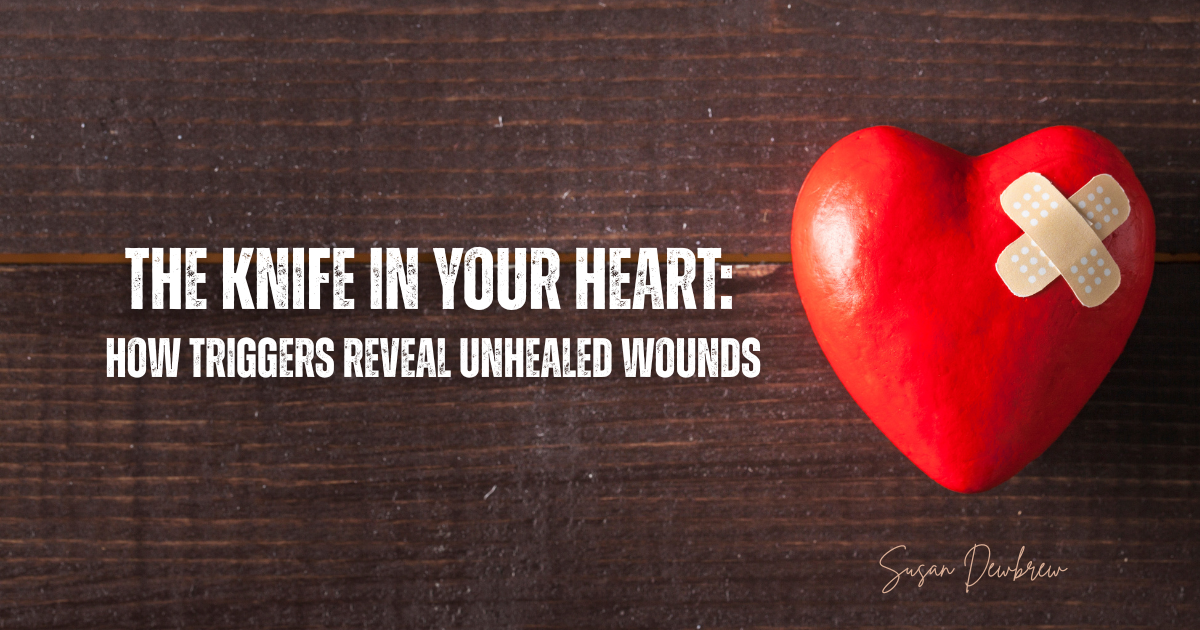
An elder once explained to me how the human psyche works with unhealed trauma: "If somebody really hurts you, it's like a knife goes into your heart. If that's not healed properly, and somebody else later brushes up against that same spot—even accidentally—it just reminds you of that original wound. You're not being stabbed again; you're just being triggered."
This is crucial to understand: there's a massive difference between being injured and being triggered.
When you're triggered, your reaction is typically out of proportion to what's actually happening in the present moment. A simple disagreement feels like an attack. A tone of voice sounds like rejection. A physical movement appears threatening when it's actually reaching for connection.
The Dance of Healing
In my previous marriage, disagreements often escalated quickly because certain dynamics felt unsafe. When Gregory and I would have a disagreement and he would start coming toward me, every alarm in my system would go off. My body remembered danger even though my mind knew Gregory posed no threat.
Yet my unhealed wounds couldn't tell the difference between past danger and present safety.
Gregory would recognize when I was being triggered and gently help me see the truth. "What did I do that triggered you?" he would ask. "This reaction seems bigger than what just happened between us."
Sometimes it was as simple as him moving toward me during a disagreement. In my previous life, that hadn't been a safe moment. But Gregory was reaching for embrace, for connection, for resolution. His nature is loving and protective, but my wounded heart interpreted his approach through the lens of old trauma.
The Unfair Demand
Here's what we cannot do: we cannot make everyone else around us adjust their behavior to protect our wounds.
This isn't healthy for us, and it's not healthy for them. When we project our pain onto innocent people, expecting them to walk on eggshells around our triggers, we're essentially demanding that the whole world accommodate our brokenness instead of pursuing healing.
Imagine if Gregory had said, "Okay, I'll never walk toward you during a disagreement." That might have prevented triggering me, but it wouldn't have healed the wound. It would have just enabled me to stay broken while requiring him to manage my dysfunction.
That's not love—it's codependence.
Taking Responsibility for Our Healing
The beautiful thing about recognizing triggers is that they reveal exactly where we need healing. Every disproportionate reaction is like a roadmap pointing toward unhealed places in our hearts.
When Gregory would say, "I'm not him," he wasn't dismissing my pain or telling me my feelings were invalid. He was helping me distinguish between past wounds and present reality so I could pursue appropriate healing.
This is what inner healing addresses—getting the knife out instead of just learning to live with the pain.
When Holy Spirit reveals the original wound, when we can see where the lie was planted or the trauma occurred, we can invite His truth and healing into that space. We can come out of agreement with the lie, forgive those who hurt us, and receive God's perspective on what really happened.
This doesn't mean the memory disappears, but the wound stops controlling our reactions. We can respond to what's actually happening instead of what our trauma tells us is happening.
The Freedom of Wholeness
What I discovered through inner healing was freedom I never knew was possible. Those old triggers began losing their power. I could experience disagreement without feeling threatened. I could see Gregory's approach as love instead of danger. I could respond to him instead of reacting to my past.
This didn't happen overnight, and it required intentional partnership with Holy Spirit. But the transformation was real and lasting.
As Gregory often helps people understand, we are tri-parte beings—spirit, soul, and body—and all three are interconnected. When our inner man gets healed, it often impacts us physically and emotionally as well. Medical science is just beginning to understand how trauma is held in our cells and how unhealed emotional wounds can manifest in physical illness.
Inner healing addresses the whole person because God created us as whole beings.
The Ripple Effect
When we take responsibility for our own healing instead of expecting others to manage our wounds, something beautiful happens in our relationships. We stop projecting pain onto innocent people. We stop requiring them to be perfect to avoid triggering us. We stop living in the past and start engaging the present.
This creates space for authentic intimacy. When Gregory knows that I'm responding to him rather than to my history, when I know that his actions come from his heart rather than from some phantom threat, we can be genuinely vulnerable with each other.
Our relationships become about who we actually are rather than about managing who we used to be.
Getting the Knife Out
If you recognize yourself in this—if you find yourself having reactions that seem bigger than the moment, if people close to you have said things like "I'm not them" or "That's not what this is"—consider that you might be carrying some knives that need to come out.
Inner healing isn't about forgetting the past or pretending trauma didn't happen. It's about partnering with Holy Spirit to heal the wounds so they no longer control your present.
You don't have to live triggered. You don't have to require everyone around you to accommodate your brokenness. You don't have to react to memories instead of responding to reality.
Holy Spirit is present in this moment, right now, ready to reveal truth that will set you free. He was there in your original wound—He never left you nor forsook you, even in circumstances contrary to His will. He can heal what was broken and restore what was lost.
The knife doesn't have to stay in your heart forever.
If you're interested in inner healing, resources like Sozo, The Exchange, and other Spirit-led healing modalities can help. You can also visit myfreedomlife.com/prophetic-ministry for free inner healing sessions. Don't let wounds from your past rob you of freedom in your present.
Blessings,
Susan 😊