
The Violence That Doesn't Leave Bruises
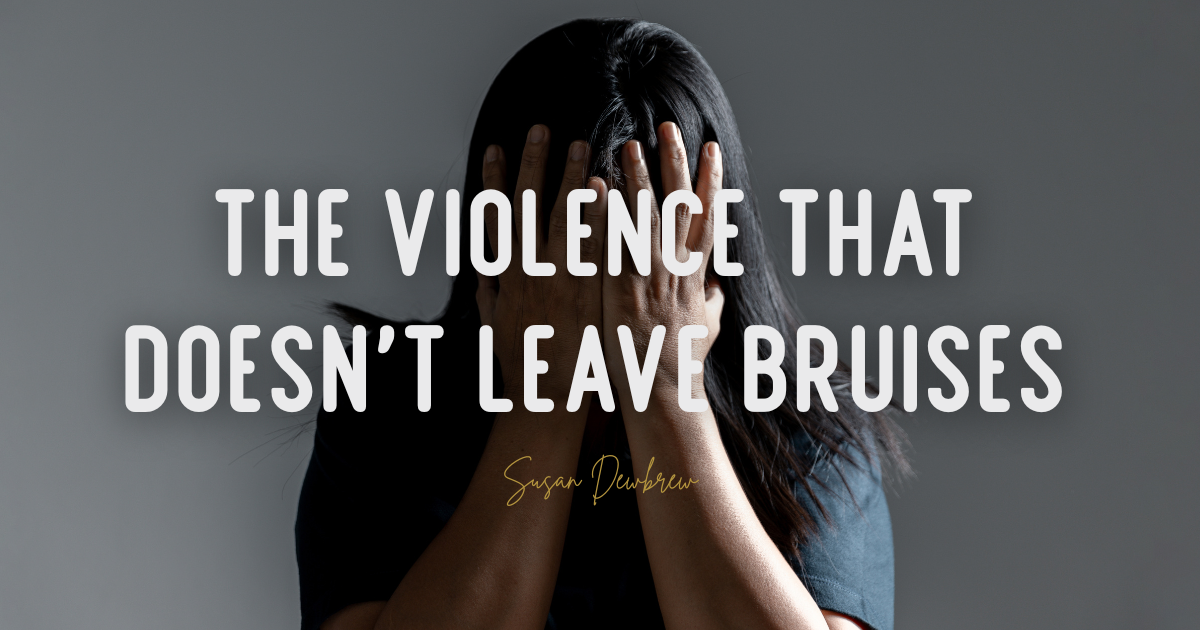
For most of my life, I carried a dangerous misconception: violence leaves a bruise. Violence breaks bones. Violence is something you can photograph, document, and prove in a court of law.
This false understanding nearly cost me and my children decades of our lives.
During my own inner healing journey, working with countless people who had suffered various forms of abuse, I came to a shocking realization: I had been experiencing violence for years without recognizing it. The manipulation, the financial control, the emotional battering, the systematic isolation—these weren't just "difficult relationship dynamics." They were acts of violence.
Violence, I learned, is any use of force to control somebody. And once I understood this broader definition, I began to see how pervasive violence really is—and how skillfully our culture, and even our churches, have learned to cover it with beautiful garments.
Redefining Violence
When we limit our understanding of violence to physical assault, we miss the vast majority of abuse that happens in relationships, families, and even religious communities. Emotional violence, financial violence, psychological violence, spiritual violence—these all use force to control another person, even when that force doesn't leave visible marks.
Consider these examples:
Financial Violence: Taking away someone's access to money, sabotaging their employment, creating debt in their name, or preventing them from working. This creates practical barriers to independence and forces compliance through economic dependency.
Emotional Violence: Systematic humiliation, isolation from support systems, constant criticism designed to erode self-worth, threats of abandonment or harm, or manipulating someone's emotions to control their behavior.
Psychological Violence: Gaslighting (making someone question their own reality), threatening suicide to manipulate behavior, deliberately creating chaos to keep someone off-balance, or using knowledge of someone's vulnerabilities against them.
Spiritual Violence: Using religious concepts to justify controlling behavior, claiming to speak for God in ways that benefit the abuser, twisting Scripture to demand submission or silence, or creating shame and guilt to maintain power over someone.
All of these involve using force—whether emotional, financial, psychological, or spiritual—to control another person's choices, behavior, or circumstances.
The Epidemic Hidden in Plain Sight
The statistics surrounding domestic violence are staggering, yet most people remain unaware of them. According to recent Johns Hopkins research:
Domestic violence is the second leading cause of death for African American women
It's the third leading cause of death for Native American women
It's the seventh leading cause of death for Caucasian women
These numbers represent an epidemic of violence that far outweighs many health crises we hear about constantly. Yet domestic violence remains largely invisible because so much of it doesn't fit our narrow definition of "real" violence.
Most domestic violence doesn't start with choking or hitting. It typically begins with the subtler forms of control I mentioned above. By the time it escalates to physical violence—or murder—there have already been countless warning signs that went unrecognized or were dismissed as "not real abuse."
How the Church Covers Violence
One of the most painful realizations in my journey has been recognizing how the church often participates in covering violence with religious garments. Just as physical abuse victims cover bruises with makeup or clothing, religious institutions often cover relational violence with spiritual language and biblical justification.
Religion's greatest fear is loss of control. Religion wants things neat and tidy, predictable and manageable. When someone's pain disrupts the system—when they speak up about abuse, when they challenge authority, when they refuse to play their assigned role—religion's instinct is often to silence them rather than address the underlying problem.
This happens in several ways:
The Magic Pill Approach: When someone reports abuse or mistreatment, they're often given simplistic spiritual formulas: "Just love more." "Submit more." "Pray harder." "Have more faith." These responses treat symptoms rather than addressing root causes, and they place responsibility on victims to fix situations they didn't create.
Preserving Appearances: Churches often prioritize maintaining the illusion of healthy families and leadership over actually creating healthy environments. The reputation of the institution becomes more important than the wellbeing of individuals within it.
Spiritual Gaslighting: Victims of abuse within religious contexts are often told they're "divisive," "rebellious," or "lacking faith" when they speak up about harmful treatment. Their very real experiences are reframed as spiritual deficiencies.
The "Suffering for Jesus" Lie
Perhaps the most damaging way churches cover violence is by equating all suffering with Christ's redemptive suffering. I can't count how many Christian counselors have told abuse victims: "Jesus suffered. You're doing Jesus-like work because you're suffering for marriage."
This is a profound misunderstanding of Scripture and a dangerous misapplication of Christ's example.
Jesus suffered to accomplish redemption—to purchase freedom for humanity and reconcile us to God. His suffering had purpose, achieved victory, and ultimately brought life.
Enabling someone's abusive behavior by enduring it without boundaries doesn't accomplish redemption—it often perpetuates destruction. It doesn't bring life; it diminishes life. It doesn't reflect Christ's sacrifice; it often enables someone else's sin.
Christ's suffering was chosen, purposeful, and ultimately victorious. Staying trapped in abusive situations out of religious obligation is often simply the result of misunderstanding what godliness actually looks like.
Creating Cultures of Shame
When churches teach people to endure harmful treatment in the name of spirituality, they create cultures of shame and guilt. Victims begin to believe lies like:
"I must not be loving enough."
"If I were more spiritual, this wouldn't be happening."
"I must deserve this treatment."
"I'm somehow causing this by not being good enough."
These lies are devastating because they prevent people from recognizing abuse for what it is and seeking appropriate help. Instead of addressing the person causing harm, all the focus is placed on the victim to somehow love, submit, or pray their way out of being mistreated.
In almost every case of abuse I've encountered, the victim has been convinced on some level that they're responsible for the abuse they're experiencing. This is how abuse can continue—because the person being harmed believes they somehow deserve it or caused it.
The Violence of Institutional Preservation
There's another form of violence that's particularly insidious: the violence of prioritizing institutions over individuals. This happens when churches, organizations, or even families decide that maintaining appearances or preserving structures is more important than protecting the people within those structures.
I think of Jesus's words about the Sabbath: "The Sabbath was made for man, not man for the Sabbath" (Mark 2:27, NKJV). The same principle applies to all our institutions, including marriage and church structures. These institutions exist to serve human flourishing, not the other way around.
When we insist that people sacrifice their safety, wellbeing, or basic human dignity to preserve institutions, we're engaging in a form of violence. We're using force—social pressure, religious obligation, guilt, shame—to compel behavior that serves the system rather than the people within it.
The Spectrum of Escalation
One of the most important things to understand about violence is that it typically exists on a spectrum and tends to escalate over time. What starts as occasional controlling behavior often becomes systematic manipulation. What begins as emotional abuse frequently progresses to financial control, then to threats, and sometimes ultimately to physical violence.
This is why it's so dangerous to dismiss "minor" forms of abuse or to tell people they should be grateful it's "not physical yet." The progression from psychological manipulation to physical assault is well-documented, and waiting until violence becomes physical often means waiting until it becomes life-threatening.
The most dangerous time in an abusive relationship is often when the victim is trying to leave. That's when the abuser's sense of control is most threatened, and that's when violence frequently escalates dramatically.
Recognizing Violence in All Its Forms
If we're going to create genuinely safe communities—in our churches, families, and relationships—we must learn to recognize violence in all its forms, not just the ones that leave visible evidence.
Here are some questions that can help identify various forms of violence:
Are you afraid to express your opinions or feelings? Fear should not be a regular feature of healthy relationships.
Do you find yourself walking on eggshells to avoid conflict? This hypervigilance is often a response to living with unpredictable or explosive behavior.
Are your resources (time, money, relationships, opportunities) being controlled by someone else? Healthy relationships involve mutual decision-making about shared resources and respect for individual autonomy.
Do you feel like you're constantly trying to prove your worth or earn basic respect? Healthy relationships provide a foundation of unconditional respect and value.
Are you isolated from support systems? Abusers often systematically separate victims from family, friends, or other sources of strength and perspective.
Do you feel like you can't make decisions about your own life? While healthy relationships involve considering others' input, they don't require permission for basic life choices.
Breaking the Silence
One reason violence continues to flourish is because we don't talk about it openly. We whisper about it in hushed conversations, we handle it "privately," and we often shame people into silence by suggesting they're somehow complicit in their own mistreatment.
But silence serves abusers, not victims. When we don't name abuse for what it is, when we don't acknowledge the full spectrum of violence, when we don't create safe spaces for people to tell their stories, we create environments where abuse can thrive.
The church should be the safest place on earth for people to find help, healing, and hope. But it can only be safe when we're honest about the forms of harm that exist and when we're committed to protecting the vulnerable rather than preserving appearances.
The True Heart of God
God's heart has always been for the protection of the vulnerable and the confrontation of those who abuse power. Throughout Scripture, we see God's concern for the oppressed:
"Learn to do right; seek justice. Defend the oppressed. Take up the cause of the fatherless; plead the case of the widow" (Isaiah 1:17, NIV).
"The Spirit of the Lord is on me, because he has anointed me to proclaim good news to the poor. He has sent me to proclaim freedom for the prisoners and recovery of sight for the blind, to set the oppressed free" (Luke 4:18, NIV).
The same God who commands us to "submit to one another out of reverence for Christ" (Ephesians 5:21, NIV) also commands those in positions of power to use their strength to serve and protect, not to dominate and control.
When we cover violence with religious garments—when we tell people to endure harmful treatment in the name of spirituality—we're not reflecting God's heart. We're reflecting the heart of the very systems Jesus came to overthrow.
Creating Truly Safer Spaces
Creating genuinely safe communities requires several commitments:
Education: We must educate ourselves and others about the full spectrum of abuse and violence. We must learn to recognize warning signs and understand the dynamics that allow abuse to continue.
Validation: When people share their experiences of harm, our first response should be to believe them and validate their experience, not to question their perceptions or suggest they might be overreacting.
Protection: We must prioritize the safety of vulnerable individuals over the reputation of institutions or the comfort of those in power.
Accountability: Those who abuse power—whether physical, emotional, financial, or spiritual power—must face appropriate consequences, not be protected by religious systems that prioritize their comfort over others' safety.
Healing: We must provide resources and support for both survivors of abuse and those who have engaged in abusive behavior. True transformation requires addressing root causes, not just managing symptoms.
Hope for a Different Way
The violence that doesn't leave bruises is real, it's pervasive, and it's devastating. But it's not inevitable. We can create relationships, families, and communities characterized by mutual honor, respect, and genuine care for one another's wellbeing.
This begins with honest acknowledgment of the problem. It continues with education, boundary-setting, and the courage to confront harmful behavior even when it's uncomfortable to do so.
Most importantly, it requires understanding that God's Kingdom is characterized not by dominance and control, but by love, service, and the empowerment of every person to become everything they were created to be.
The violence that doesn't leave bruises may be harder to see, but once we learn to recognize it, we can begin to address it. And once we address it, we can participate in God's work of bringing healing, freedom, and genuine shalom to a world that desperately needs it.
We don't have to live in fear. We don't have to accept manipulation as love or control as care. We can choose relationships that reflect God's heart—relationships where power is used to lift up, not tear down; where strength is used to protect, not dominate; where love creates freedom, not bondage.
This is what God's Kingdom looks like when it's unleashed in our relationships. This is what happens when we choose the tree of life over the tree of the knowledge of good and evil. This is the hope we can offer to a world wounded by violence in all its forms.
If you recognize yourself in this description of non-physical violence, please reach out for help. You deserve relationships that are safe, respectful, and life-giving. Resources like the National Domestic Violence Hotline (1-800-799-7233) and Wilderness2Wild.com can provide valuable support and information.
Blessings,
Susan 😊