
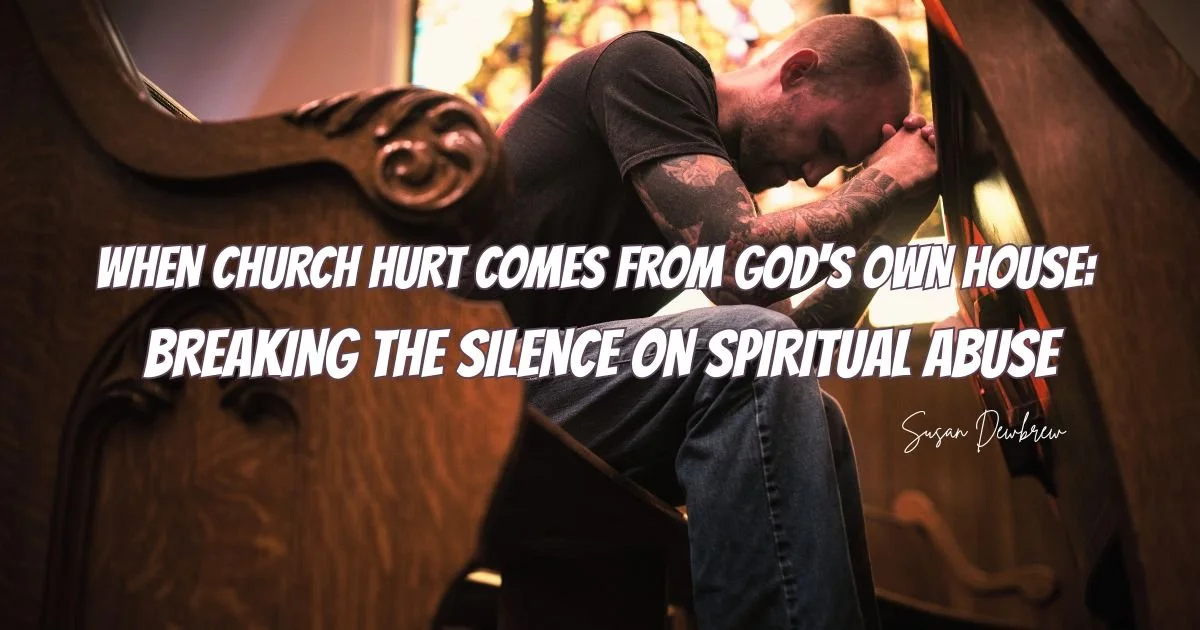
When Church Hurt Comes from God's Own House: Breaking the Silence on Spiritual Abuse
The umbrella model looks so innocent, doesn't it? God at the top, Christ beneath Him, then the husband, then the wife, then the children. It's presented as divine protection—a benevolent covering that keeps families in "God's order" and Satan at bay.
But I've learned that sometimes Satan operates most effectively not from outside this umbrella, but from within it.
The Benevolent Disguise
When I first encountered the umbrella model years ago, it was taught by Bill Gothard through his Basic Institute of Life Principles. The teaching was compelling: follow this God-given authority structure, and your family will be blessed. Step out of it, and you invite destruction.
What made it particularly seductive was how benevolent it appeared. This wasn't presented as harsh authoritarianism—it was "loving leadership" and "protective covering." Men weren't supposed to be tyrants; they were supposed to be Christ-like servant leaders. The whole system seemed designed to honor both authority and love.
But here's what I discovered: when you create a power structure that says one person has inherent authority over another simply because of their gender, you create the perfect conditions for abuse to flourish. And when you wrap that structure in religious language and claim it's "God's design," you make it nearly impossible for victims to seek help or even recognize they're being harmed.
My Journey from Victim to Advocate
I speak from personal experience. For twenty years, I lived in a marriage where I was "often pressured through emotional or physical intimidation" to submit to my husband's will. As I share in BLIND SPOT, "when you live in a home like that, you don't want to upset the 'powerful one.' So, you and your children are constantly walking on eggshells, praying one of them doesn't crack and make him mad."
The tragic irony? I was serving in a large marriage ministry, teaching other women about biblical submission and trying desperately to perfect my own. I genuinely believed that if I could just submit better, love more, and respect more deeply, I could transform my marriage. I poured into other marriages, hoping God would honor my faithfulness by fixing my own.
It took me two decades to realize that the problem wasn't my insufficient submission—it was a system that enabled and even encouraged abuse while blaming victims for not submitting "correctly."
The Victim-Blaming Cycle
Here's how the system works: when a woman experiences abuse within this "biblical" structure, she's told the problem lies with her. She needs to:
Submit better
Love more unconditionally
Show greater respect
Stop being rebellious
Pray harder for her husband
Trust God's plan
If the abuse continues or escalates, the focus remains on her supposed failures. Church leaders ask questions like "What did you do to provoke him?" or "Are you being submissive enough?" They rarely ask "Why is he choosing to abuse his power?"
Even more devastating, women are often told that enduring abuse is Christ-like. They're reminded that "Jesus suffered and he went to the cross, he received abuse. And so you can do that too." Children in these homes are taught the same twisted theology—that suffering under an abusive authority figure is somehow godly.
The Perfect Shield for Predators
What makes this system particularly insidious is how it provides perfect cover for predators and abusers. When someone's authority is presented as God-given and unchallengeable, questioning their behavior becomes tantamount to questioning God Himself.
The tragic example of Bill Gothard himself illustrates this perfectly. Here was a man teaching "biblical authority structures" while allegedly using those very structures to enable his own predatory behavior. The power pyramid he promoted created the conditions that protected him and silenced his victims.
This isn't an isolated incident. When we establish systems where some people have inherent authority over others, and when we make questioning that authority spiritually dangerous, we create hunting grounds for those who would exploit and harm.
The Church's Complicity
What breaks my heart most is how the church—God's own house—has often become complicit in this abuse. Instead of being a place of refuge for the wounded, it has too often been a place where wounds are inflicted and then covered up in the name of "biblical order."
Church leaders, trained to uphold traditional authority structures, often respond to reports of abuse by:
Counseling women to return to abusive situations
Minimizing emotional, psychological, and spiritual abuse
Focusing on "restoring" marriages rather than ensuring safety
Blaming victims for not being submissive enough
Protecting the reputation of male leaders and institutions
As one podcast participant noted, there's growing awareness of different types of abuse beyond physical violence. Organizations like Focus on the Family are beginning to acknowledge emotional abuse. But awareness isn't enough if we're not willing to empower women to take action when they recognize these patterns.
Breaking the Silence
The time has come to break the silence around spiritual abuse and acknowledge how "biblical" teachings have been weaponized against the vulnerable. We must:
Name the Problem: Dominance-based hierarchy, even when wrapped in religious language, creates conditions ripe for abuse.
Stop Victim-Blaming: When someone reports abuse, our first response should be concern for their safety, not questions about their submission.
Challenge False Teaching: The umbrella model and similar hierarchical structures are not God's design—they're human distortions that contradict Christ's example of servant leadership.
Prioritize Safety: No theological interpretation should ever require someone to remain in an abusive situation.
Listen to Survivors: Those who have experienced spiritual abuse often have the clearest vision of how these systems operate and how they can be changed.
God's True Design
The beautiful truth is that God's actual design for relationships looks nothing like the power pyramid structures that enable abuse. When we study Scripture carefully, we discover that God's Kingdom operates on mutual submission, mutual honor, and mutual empowerment.
As Ephesians 5:21 (ESV) clearly states: "Submit to one another out of reverence for Christ." This mutual submission creates safety, not vulnerability. It distributes power rather than concentrating it. It protects the vulnerable rather than exposing them to harm.
A Call to Courage
If you're reading this and recognizing patterns of spiritual abuse in your own life or community, know that speaking up isn't rebellion—it's faithfulness to God's true heart for relationships.
If you're a leader who has unknowingly perpetuated these harmful systems, there's grace for repentance and transformation. But transformation requires acknowledging the harm these structures have caused and committing to something better.
The fall of Babylon—these corrupt religious systems that have perverted true faith—is not something to fear. It's something to celebrate, because it makes way for God's Kingdom to emerge in its true beauty: a community built on love, not power; on service, not domination; on mutual honor, not hierarchical control.
The time for bold and courageous action is here. That bold action is simply walking out the truth in love, refusing to allow God's house to be a place where the vulnerable are harmed in His name.
God's Kingdom is coming, and in that Kingdom, the last shall be first, the servant shall be greatest, and love—not power—will have the final word.
Blessings,
Susan 😊