
Why Would God Send Mary?
There are moments in life that get seared into your memory—moments so profound they become the before-and-after markers of your spiritual journey. For me, that moment happened in my garage on an ordinary morning that became anything but ordinary.
I had just dropped my kids off at their little Christian school and pulled back into the garage. As I got out of the car and walked around toward the kitchen, I heard something that stopped me in my tracks. It was internal, but unmistakably clear—the voice of the Lord speaking directly to my heart:
"Susan, why would I send Mary knowing they wouldn't believe me?"
The question hit me like lightning. Instantly, I knew He was talking about Mary Magdalene. I knew He was referring to the greatest message ever delivered: "He has risen!" And I knew this was about to change everything I thought I understood about God's design for women.
The Weight of the Question
You see, at that time I was deeply involved in a church that taught complementarian theology—the belief that while men and women have equal value, they have different roles, with husbands as the authority and wives as the helpers and followers. I had actually served in a large marriage ministry devoted to traditional teaching on submission and headship, hoping that by submitting and pouring into other marriages, I could somehow transform my own difficult situation.
I was taught that women couldn't teach adult men, that we should remain silent in church, and that our God-given role was to follow male leadership. When you're new in the faith and growing rapidly in your understanding of Scripture, these teachings can feel like relief at first. Finally, I thought, someone is celebrating me for being a mom instead of looking down on me for leaving the corporate world.
But God's question in that garage shattered my comfortable assumptions.
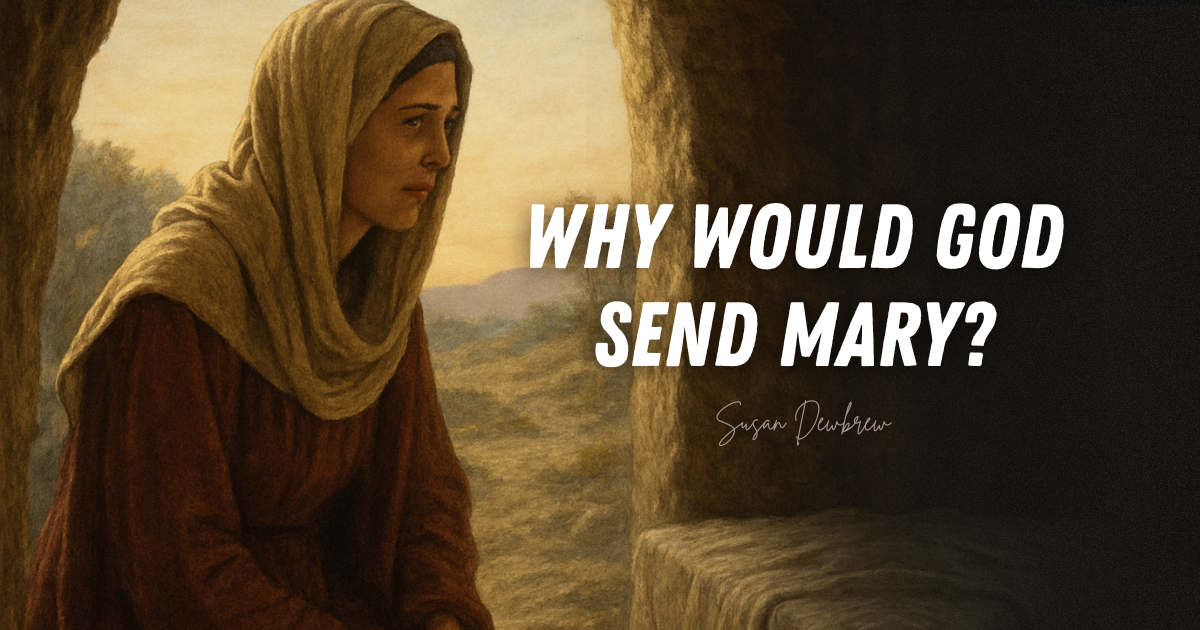
Why would the risen Christ—in the most important moment in human history—choose Mary Magdalene as His first herald? In that culture, women couldn't even give testimony in a court of law. Even if a woman witnessed a murder, her testimony meant nothing legally. She was among the most marginalized people in society—not just as a woman, but as one from whom Jesus had cast out seven demons.
Yet Jesus chose her to deliver the greatest sermon ever preached.
Wrestling with the Implications
In that moment, everything in me shifted. I knew with absolute certainty that what I was being taught about women wasn't correct. But I was young in the Lord and admittedly naive. I thought, Well, I'll just go study this out and show everyone where we got it wrong. How hard could it be?
It turned out to be much harder than I expected.
The first verse I looked up was 1 Corinthians 14:34: "Women should remain silent in the churches." When I dug into the Greek, I discovered it was actually much stronger than the English translation suggested. It wasn't just about not giving speeches—the original language meant they shouldn't make any sound at all. This seemed to contradict not only the Lord's word to me but also common sense and other passages where women clearly participated in church.
For years, I wrestled between what my heart knew the Lord had spoken and what traditional interpretations seemed to say. I read complementarian scholars and biblical egalitarians. I studied Greek lexicons and different translations. Neither side fully satisfied me intellectually, though I never doubted that initial word from the Lord.
What I didn't yet understand was that this wasn't just about getting a few verses right. It was about recognizing an entire spiritual system that had infiltrated the Church—a system that Jesus Himself came to confront and dismantle.
The Divine Disruption
Looking back now, I see that God's choice of Mary Magdalene wasn't an exception to His character—it was the perfect expression of it. Throughout Scripture, God consistently chooses the least likely candidates to accomplish His greatest purposes:
David was the youngest and smallest of Jesse's sons
Moses had a speech impediment
Gideon was hiding in a winepress
Mary was an unwed teenager
The disciples were uneducated fishermen
And Mary Magdalene? She was the most marginalized person in a marginalized group, yet God chose her to be the first evangelist of the resurrection.
This is divine disruption at its finest. Jesus wasn't just making a statement about geography when He said, "My kingdom is not of this world" (John 18:36). He was introducing an entirely different operating system for human relationships—one that turns worldly power structures upside down.
What This Means for Us Today
The question "Why send Mary?" continues to challenge us today. If God was willing to bypass every social convention and cultural expectation to accomplish His purposes then, what does that tell us about His heart for women now?
It tells us that:
God's kingdom operates on completely different principles than the world's power systems
He delights in using those the world considers "least" to accomplish the "greatest" things
Women have always been essential to God's redemptive plan, not afterthoughts or supporting players
The Church's role is to reflect God's revolutionary values, not accommodate cultural limitations
Your Garage Moment
Perhaps you've had your own "garage moment"—a time when the Holy Spirit whispered something to your heart that challenged everything you'd been taught. Maybe it was about women's roles, or maybe it was about something else entirely.
Don't dismiss those moments. Don't let traditional interpretations or cultural expectations silence what the Spirit of Truth is revealing to your heart. Just as Mary Magdalene was faithful to deliver the message she'd been given, even knowing the disciples might not believe her, we're called to be faithful to the truth God reveals to us.
The same God who sent Mary to announce the resurrection is still in the business of choosing unlikely messengers to deliver His truth. The question isn't whether we're qualified by human standards—it's whether we're willing to be faithful with what He's entrusted to us.
Why did God send Mary? Because He wanted to free the most oppressed people group in that culture. Because He knew that if the gospel could transform how we treat women—the most marginalized—it could transform everything.
And that transformation is still happening today, one heart at a time, one garage moment at a time.
What has the Lord whispered to your heart lately? What truth is He asking you to carry forward, even if others might not believe you at first? Your story—like Mary's—might be exactly what someone else needs to hear.
Blessings,
Susan 😊