
Beyond the Institution: When Leaving Church Leads You Closer to Jesus
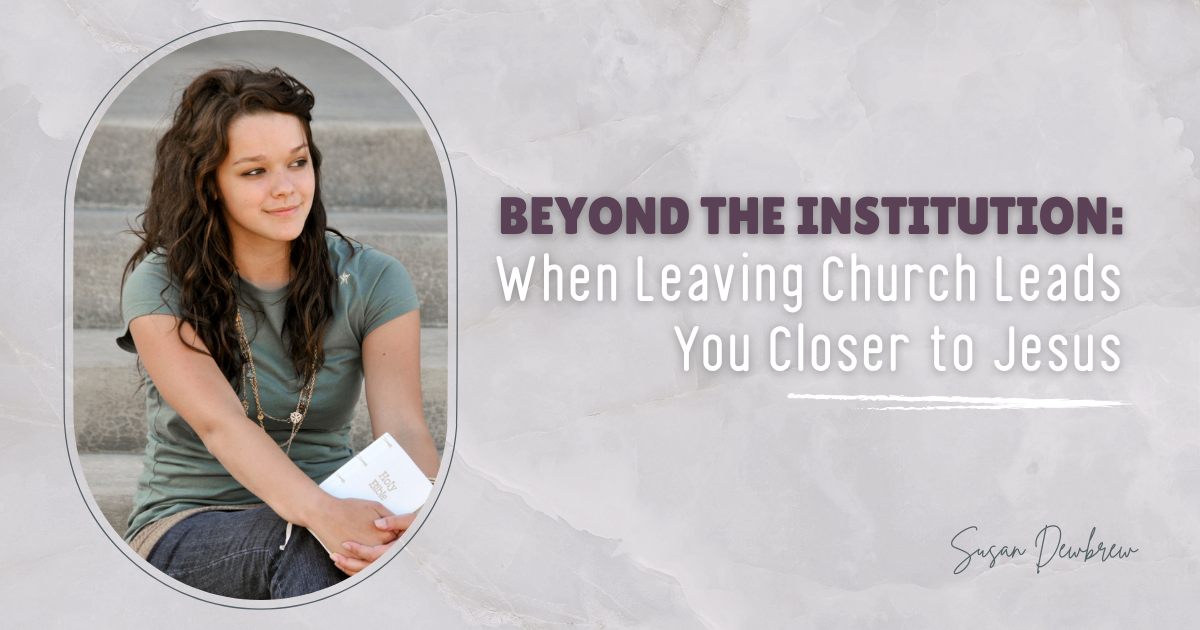
The text arrived early one morning from my friend Heather Elizabeth: "Susan, I've had to step away from toxic corporate institutionalized religion. And honestly, it's like this weight has just lifted off of me. The last two years has been me and Jesus."
Her words hit me deeply because I understood exactly what she meant. Sometimes the most spiritually healthy thing a person can do is walk away from church—not from Jesus, but from religious systems that have become more about preserving institutions than protecting people.
This distinction—between faith and religious systems—has become increasingly important as I've watched countless believers struggle with what's being called "deconstruction" or "dechurching." Many aren't losing their faith; they're discovering what authentic faith looks like when stripped of toxic religious programming.
The Difference Between Leaving Jesus and Leaving Church
When Heather shared that she needed to step away from organized religion to focus on "me and Jesus," she wasn't describing rebellion or backsliding. She was describing recovery.
After surviving both childhood and domestic abuse, then experiencing additional trauma through spiritual abuse, Heather needed space to discover who Jesus really is apart from the religious leaders who had used His name to shame, control, and silence her.
Her experience echoes that of many abuse survivors I know. When spiritual authority figures respond to abuse disclosures with victim-blaming, when Scripture gets weaponized to keep people in harmful situations, when "submission" becomes a tool of oppression rather than a beautiful expression of mutual love—sometimes the kindest thing Jesus does is draw people away from those environments entirely.
This isn't God abandoning the Church; it's God rescuing His children from systems that have forgotten His heart.
When the Institution Becomes the Idol
One of the most profound insights I've gained is recognizing when church institutions become what we serve instead of vehicles for serving God's people. As someone shared with me recently, "When the institution is what we're trying to save, then people become victims of the institution."
I've seen this pattern repeatedly: when a crisis threatens to expose problems or damage a church's reputation, leaders often circle the wagons to protect the brand rather than protect the people. Abuse gets covered up to preserve the ministry. Victims get silenced to maintain unity. Truth gets sacrificed on the altar of institutional preservation.
But Jesus never prioritized religious institutions over people. In fact, He consistently challenged religious leaders who did exactly that. When the Pharisees prioritized Sabbath rules over human need, Jesus declared, "The Sabbath was made for man, not man for the Sabbath" (Mark 2:27, NKJV).
The same principle applies to churches, marriages, and any other institution. They exist to serve human flourishing, not the other way around.
The Beauty of Two or Three Gatherings
When Jesus said, "For where two or three are gathered together in My name, I am there in the midst of them" (Matthew 18:20, NKJV), He was revealing something profound about authentic Christian community. His presence isn't dependent on buildings, programs, or official structures—it's found wherever people gather in genuine pursuit of Him.
Heather discovered this truth during her healing journey: "I do a lot of two or more gatherings with people intimately. I have the group, of course, where we support one another, but toxic corporate institutionalized religion... I just think we're back for now."
There's something powerful about intimate gatherings where people can be authentically themselves without performance or pretense. Where conversations flow naturally from the heart rather than scripted programs. Where Holy Spirit can move without being constrained by institutional protocols.
This doesn't mean all organized churches are bad or unnecessary. But it does mean that sometimes God draws people back to simpler, more authentic expressions of faith to heal from religious trauma and rediscover His true nature.
The Path Back to Healthy Community
For those who've stepped away from organized religion, the question often arises: "Will I ever find healthy church community again?"
The answer depends on what they're looking for and what's available in their area. Heather expressed it this way: "I hope that it comes. I pray that it comes. But for me right now, the best thing is to not be a part of that because I just need to get better."
Healing takes priority. And sometimes healing requires distance from environments that triggered the original wounds.
For those ready to explore community again, here are some signs of healthier church environments:
Humility over authority. Leaders who are willing to admit mistakes, learn from others, and change course when needed rather than demanding unquestioning submission.
People over programs. Communities that prioritize individual well-being over institutional success, even when it's costly or inconvenient.
Questions welcomed. Environments where doubt, struggle, and wrestling with faith are seen as normal parts of spiritual growth rather than threats to be silenced.
Mutual submission practiced. Churches that actually live out Ephesians 5:21—"submitting to one another in the fear of God" (NKJV)—rather than creating rigid hierarchies.
Transparency over image management. Leaders who are honest about their struggles and the church's challenges rather than maintaining perfect facades.
Building Bridges Without Forcing Returns
One of the most important things those of us in church leadership can do is resist the urge to pressure people back into organized religion before they're ready. When someone shares that they've stepped away from church for their spiritual health, our response should be celebration of their pursuit of authentic faith, not concern about their church attendance.
I think about the young people I've mentored over the years who left institutional church due to spiritual abuse. Rather than trying to convince them to return, I've gone back to apologize: "I'm sorry for anything I have done or said that has caused you to question the goodness of God."
This is bridge-building—creating connections that honor people's journeys rather than demanding they conform to our expectations of what their faith should look like.
What the Exodus Reveals
The current exodus from organized religion isn't necessarily a crisis of faith—it's often a crisis of religious systems that have prioritized institutional preservation over spiritual health. When we see people leaving churches in droves, our first question shouldn't be "How do we get them back?" but "What drove them away?"
Sometimes God uses what looks like loss to create space for renewal. Sometimes the old wineskins need to burst before new ones can be formed. Sometimes institutions need to fall before authentic faith communities can emerge.
As I wrote in my blog about the fall of Babylon, "The fall of dominance-based hierarchy in the Church isn't something to fear—it's something to celebrate. It signals not the Church's destruction but its purification."
The Revolution of Love
What excites me most about this season is seeing authentic expressions of Jesus' love emerging outside traditional structures. I see it in Heather's Facebook group where over 1,600 women support each other's healing journeys. I see it in small gatherings where people encounter God's presence without religious performance. I see it in survivors who've discovered that Jesus is nothing like the religious leaders who wounded them.
This is the revolution Jesus came to bring—not new religious programs but authentic relationships rooted in love, honor, and mutual service. Sometimes this revolution happens within existing churches. Sometimes it happens in living rooms, coffee shops, and online communities.
The key isn't the structure; it's the Spirit.
An Invitation to Freedom
If you've stepped away from organized religion for your spiritual health, please know that your journey is valid. Jesus isn't disappointed in you for choosing authenticity over religious performance. He isn't punishing you for refusing to stay in toxic environments. He's proud of you for pursuing truth even when it costs you religious approval.
And if you're in church leadership, I invite you to examine whether your institution serves people or whether people serve your institution. Are you creating environments where wounded people find healing, or where they experience additional trauma? Are you prioritizing God's Kingdom or your religious kingdom?
The most courageous thing church leaders can do is create space for people to encounter Jesus authentically—even if that means some people need to step away from organized religion for a season. Sometimes the greatest act of pastoral care is blessing someone's journey away from your church.
Because ultimately, we're not called to build religious empires. We're called to point people to Jesus. And sometimes He's found more clearly outside our institutions than within them.
The Kingdom of God is bigger than any building, denomination, or religious system. It's wherever Jesus' love transforms hearts and relationships. It's wherever mutual submission replaces power struggles. It's wherever authentic community flourishes.
And sometimes, that's exactly where people find it when they step away from church and into the arms of Jesus Himself.
Blessings,
Susan 😊