
The Courage to Question: My Journey from Role-Based to Relationship-Based Marriage
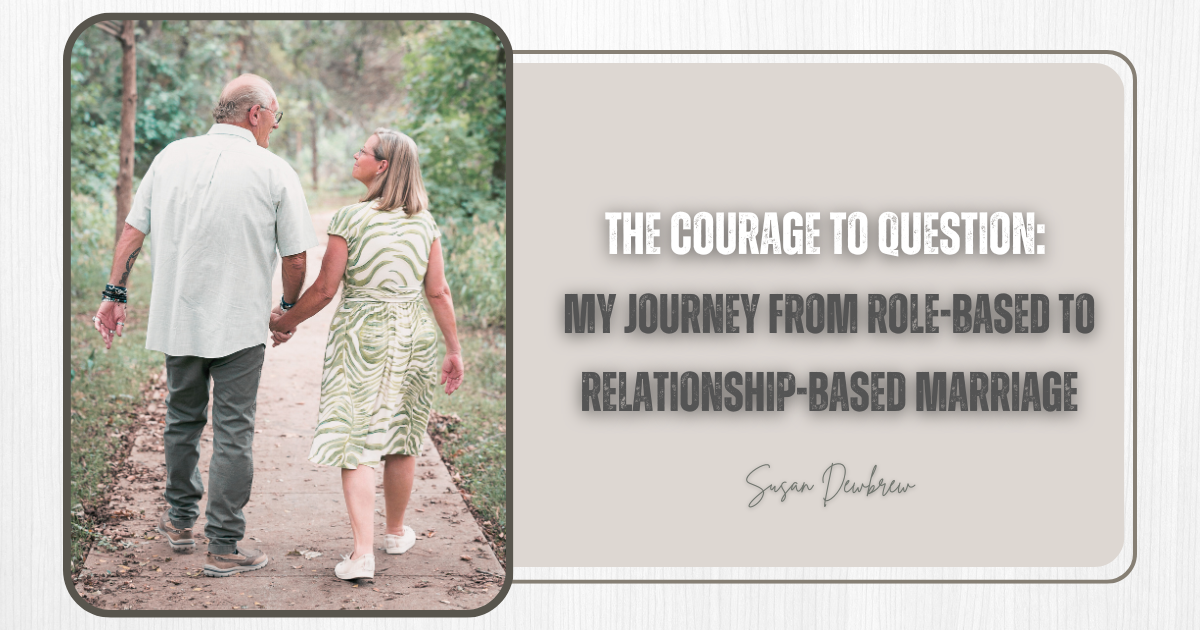
If you've grown up being told that your primary role is to serve your man and stand by him no matter what, the moment you start questioning that paradigm can feel like an identity crisis.
I know because I lived it.
For the first six years of my Christian walk, I dove headfirst into every class, every study, every opportunity to learn Scripture. I loved every minute of it—church three times a week, home groups, conferences, you name it. But permeated throughout that entire experience was one consistent message: God had a specific design for male and female relationships, and that design was hierarchical.
It didn't matter what flavor of Christianity I was studying. Even the most liberal denominations that released women in ministry still held onto the idea that "at home," a woman's creation was to be the man's helper, homemaker, and support system. Her role was to be under his authority as the head, provider, and protector.
And honestly? Sometimes that paradigm could be beautiful. There are seasons when we're called to play supporting roles. But when your entire being gets defined by a role and a function—when your identity becomes completely wrapped up in serving someone else's vision—something precious gets lost.
When Identity Becomes Function
As the light began dawning that this might not actually be God's design, I found myself in a terrifying place: Well, then what am I?
I was so used to being defined by role that I couldn't imagine existing any other way. It wasn't just about marriage—I'd unconsciously carried this same paradigm into my relationship with the Lord. Instead of understanding that fruit is born from a love relationship, I was constantly asking, "What am I supposed to do for you, Master?"
I had become a human doing instead of a human being.
This is what happens when we reduce relationships to functions and formulas. We start measuring our worth by how well we fulfill predetermined roles rather than by the love we give and receive. We become performance-based rather than relationship-based.
The False Paradigm of "Should"
Looking back, I realize how much energy I wasted trying to force myself and my relationships into boxes that didn't fit. I had mental pictures of what Gregory "should" do because he was the man, and I spent way too much time feeling disappointed when he didn't automatically fulfill those expectations.
Take car maintenance, for example. My father had drilled it into me that mechanics would take advantage of me because I was female and knew nothing about cars. So I decided that car care was obviously "man's work" and expected Gregory to handle it. When he suggested I was perfectly capable of driving to the oil change place myself, I felt hurt and abandoned.
But here's the thing: we'd never actually agreed that car maintenance was his responsibility. I'd just assumed it based on cultural programming. I was building resentment over an expectation that existed only in my head.
The Terror of Transition
When you start questioning beliefs you've held your entire life—especially beliefs tied to your identity and relationships—it's terrifying. There's a reason most people don't do it. It's easier to stay in a box that feels secure, even if it's limiting, than to venture into unknown territory.
I remember the internal turmoil of those early questioning days. Part of me was excited by the possibility of something more, something truer. But another part was terrified of losing everything I thought I knew about myself and my purpose.
If I'm not primarily a helper and supporter, then who am I? If my identity isn't wrapped up in my role as a wife, then what defines me? If God doesn't require me to submit to male authority, then how do I relate to Him?
These weren't just theological questions—they were existential ones.
The Shift from Role to Relationship
The breakthrough came when I began to understand that true partnership isn't about fitting together like puzzle pieces with predetermined shapes. It's not about being "number two" to someone's "number one." It's about becoming one—truly one, not in a hierarchy but in unity.
When Gregory and I approach our marriage as genuine partners, our roles can shift and be fluid in different seasons. As long as we're both in agreement and both yielding to one another, it becomes beautiful rather than restrictive.
This shift from role-based to relationship-based marriage was revolutionary for me. Instead of asking "What should I do?" I started asking "How can we serve each other and serve God together?" Instead of focusing on my function, I started focusing on our connection.
The Freedom of Authenticity
Here's what I discovered: when you stop trying to fulfill someone else's expectations of who you should be and start living authentically in relationship, everything changes. You stop performing and start simply being. You stop keeping score and start serving from overflow.
Gregory doesn't love me because I cook his meals or keep his house (though I sometimes do both). He loves me because of who I am—my heart, my mind, my unique perspective, my dreams, my calling. Similarly, I don't love him because he fixes things or provides financially (though he does both). I love him for his character, his servant's heart, his wisdom, his gentle strength.
When love is based on relationship rather than performance, it creates safety for both people to be authentic. We can have off days, pursue individual callings, change and grow, even disagree—and the love remains constant because it's not dependent on role fulfillment.
The Ripple Effects
This shift didn't just change my marriage—it transformed every relationship in my life. I stopped relating to God as a demanding master who required perfect performance and started experiencing Him as a loving Father who delights in relationship. I stopped seeing other women as competition and started seeing them as sisters and collaborators.
Most importantly, I stopped defining my worth by how well I fulfilled cultural expectations and started finding my identity in being God's beloved daughter, created with unique gifts and callings that aren't limited by my gender.
The Journey Continues
I want to be honest: this journey isn't a destination you arrive at and then you're done. Gregory and I still catch ourselves falling into old patterns sometimes. Cultural programming runs deep, and it takes intentional effort to continue choosing relationship over role, authenticity over performance.
But that's okay. Growth is a process, and every time we catch ourselves and make the correction, we're choosing Kingdom reality over worldly systems.
For Those in the Questioning Stage
If you're reading this and feeling that familiar stirring of questions—if you're wondering whether there might be more to relationships than the roles you've been taught—I want to encourage you: those questions are not rebellion. They might be the Holy Spirit leading you into deeper truth.
It takes courage to question long-held beliefs, especially when those beliefs are wrapped up in your identity and relationships. But I can tell you from experience: the truth really does set you free.
You don't have to choose between honoring God and living authentically. You don't have to choose between biblical marriage and genuine partnership. You don't have to sacrifice your identity to serve someone else's.
God's design for relationships is more beautiful, more liberating, and more reflective of His own nature than many of us have been taught. It's worth the journey to discover it.
The Invitation
The journey from role-based to relationship-based living requires courage, patience, and grace—for yourself and others. It means being willing to examine assumptions you've never questioned. It means having conversations that might feel uncomfortable. It means choosing love over control, service over dominance, authenticity over performance.
But it also means stepping into the fullness of who God created you to be. It means experiencing relationships the way He intended—as partnerships that reflect His own nature of mutual love, honor, and submission.
The question isn't whether you're brave enough to start questioning. The question is whether you're willing to let God's truth transform your understanding of what relationships can be when they're built on His Kingdom principles rather than the world's hierarchies.
What beliefs about relationships or roles are you questioning? What would change in your life if you approached relationships from authenticity rather than expectation? I'd love to hear about your own journey.
Blessings,
Susan 😊