
The Least Effective Form of Abuse (And Why We Keep Looking for Bruises)
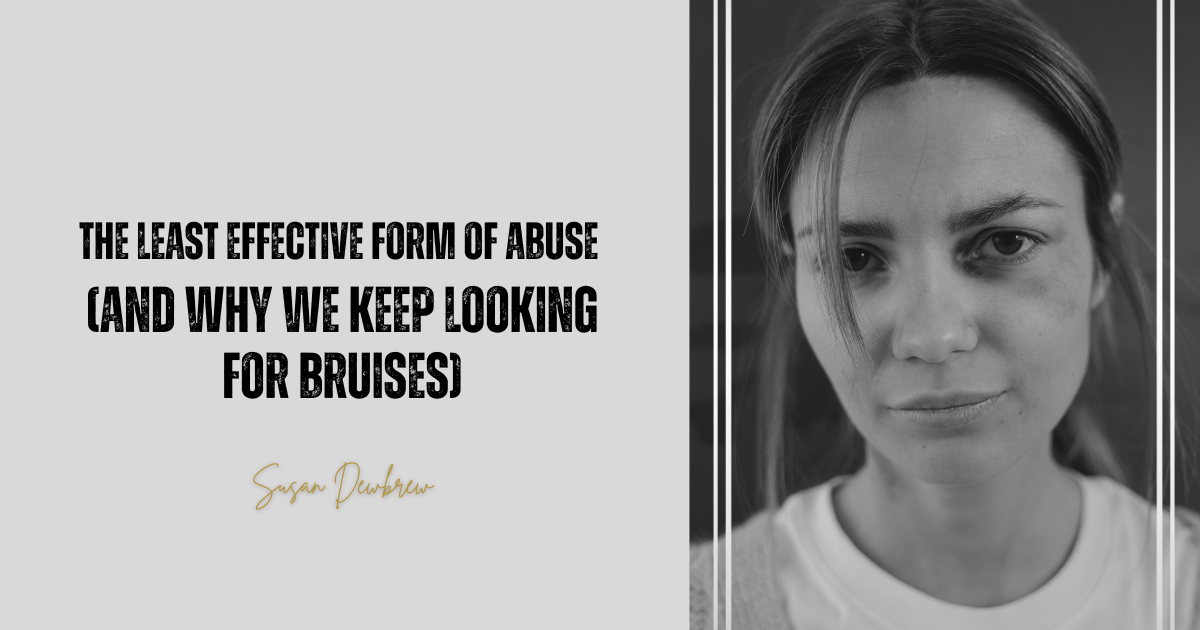
My daughter Jaclyn said something recently that stopped me in my tracks: "The least effective form of abuse to control the victim is violence—the least effective. Emotional abuse is much more effective in controlling someone."
I sat there absorbing that statement, thinking about all the times I'd drawn my line in the sand: "If he ever hits me, I'll leave." As if physical violence was the only real abuse. As if bruises were the only proof that something was truly wrong.
But Jaclyn was right. Physical abuse is actually the bluntest, least sophisticated tool in an abuser's arsenal. And focusing only on physical violence means we're looking in completely the wrong place.
The Line I Drew (That Kept Me Trapped)
In my first marriage, I was very clear about my boundary: physical violence would be the end. He knew it, and I knew it. So he never crossed that line—not technically.
But he did everything else.
He threw guns on the bed to make sure I was intimidated, knowing I understood he was unstable enough to use them. When we heard noises outside our country home at night, guess who had to get up and investigate? Not the man with the weapon—me. Because he threatened to shoot strangers who came to the door, and I couldn't let innocent people die.
Does that make sense? I became the one taking physical risks because I was more afraid of his potential violence toward others than I was of putting myself in danger.
This is the twisted logic that abuse creates. You start making decisions based on fear of what the abuser might do, not just what they have done.
But since there were no bruises, I told myself it wasn't "real" abuse.
Why Physical Violence Is Actually Ineffective
Think about it logically: if someone hits you, you know you've been abused. The evidence is clear. You might make excuses for it, but part of you knows this is wrong.
Physical violence also only controls you in the moment. When someone hits you, you might comply out of fear right then, but it doesn't necessarily change your long-term thinking or create the deep psychological dependence that abusers actually want.
More importantly, physical abuse often leaves evidence. Bruises can be seen. Medical records get created. Other people might notice and ask questions.
But emotional and psychological abuse? That's the insidious stuff. That's what really gets into your head and heart and makes you question everything you know about reality.
The Conditioning Process
Abusers don't start with their worst behavior. They condition you slowly, like the proverbial frog in boiling water. The temperature rises so gradually that you don't realize you're being cooked alive.
It might start with:
"Innocent" jokes that hurt your feelings, followed by "Can't you take a joke?"
Small criticisms about your appearance, your cooking, your personality
Gradually isolating you from friends and family
Creating financial dependence
Making you feel like you're "too sensitive" or "making mountains out of molehills"
Each incident, by itself, might seem manageable. You might think, "Well, everyone has flaws" or "Marriage requires compromise" or "Maybe I am being too sensitive."
But over time, these small erosions of your dignity, confidence, and autonomy create something much more powerful than fear of being hit. They create a fundamental confusion about reality itself.
Living in Intimate Terrorism
I learned a term that perfectly describes what I experienced: intimate terrorism. It's living in fear of the other person's power. It's where one partner is always walking on eggshells, worried about the next time something will go wrong.
Here's what people don't understand about abusive relationships: they're not all bad. If they were all bad, we would leave quickly. I used to say, "If it was all bad, I would have left a long time ago. We had a lot of great times too."
But there was always this underlying tension—this little voice in the back of my mind wondering when things would turn. When he'd fly off the handle about something small. When he'd become sullen and punishing. When the atmosphere in the house would shift from peaceful to walking-on-eggshells.
You start measuring your words, managing your facial expressions, anticipating his moods, trying to head off problems before they start. You become hypervigilant, always scanning for signs that a storm is coming.
That constant state of alert is exhausting. It's also incredibly effective at control, because it means the abuser doesn't have to do anything overt to maintain power. The fear of their potential reaction becomes the prison.
Why Emotional Abuse Is So Devastating
Emotional and psychological abuse work by systematically breaking down your sense of reality. Abusers are masters at making you question your own perceptions, feelings, and experiences.
"You're overreacting." "That's not what happened." "You're remembering it wrong." "You're too sensitive." "I was just kidding—why are you taking it so seriously?"
Over time, you start doubting yourself. Maybe you are overreacting. Maybe your feelings aren't valid. Maybe you are remembering things wrong.
This is called gaslighting, and it's one of the most damaging forms of abuse because it attacks your ability to trust yourself. When you can't trust your own perceptions, you become dependent on the abuser to tell you what's real.
Physical abuse hurts your body. Emotional abuse destroys your soul.
The Power of Recognition
The moment I started learning the language of abuse—terms like "gaslighting," "emotional manipulation," "financial control," "isolation"—everything changed. Suddenly, I had words for experiences I couldn't previously describe.
When you can name what's happening to you, the abuser loses a powerful tool: confusion. They can no longer make you question whether something is really abuse or just "normal relationship problems."
This is why bringing clarity to these patterns is so important. It's not about creating drama or destroying marriages. It's about giving people the tools to recognize when they're in danger, even when that danger doesn't leave visible bruises.
Looking for the Right Signs
If we're only looking for physical violence, we're missing the vast majority of abuse that's happening. We need to learn to recognize:
Patterns of control and manipulation
Systematic erosion of self-esteem
Isolation from support systems
Financial control or dependence
Constant criticism disguised as "help"
Using children, culture, or religion to maintain control
Making you feel like you're walking on eggshells
Denying or minimizing their harmful behavior
These patterns are just as devastating as physical violence—sometimes more so, because they're harder to identify and easier to minimize.
The Gospel Truth
Jesus said, "You will know the truth, and the truth will set you free" (John 8:32, ESV). Truth brings freedom, while lies bring bondage.
Abuse thrives on lies—lies about what's normal, lies about what you deserve, lies about what love looks like. It requires confusion and secrecy to maintain its power.
But when Holy Spirit brings clarity—when you can finally see and name what's been happening—the lies lose their grip. The truth becomes a weapon against the darkness.
This is why learning about abuse patterns isn't just practical—it's spiritual warfare. Every person who gains clarity about abuse is one more person the enemy can't keep trapped in confusion.
If you're reading this and recognizing patterns in your own relationship, please know: you're not crazy, you're not overreacting, and you don't have to live this way. Physical bruises aren't the only evidence that matters. Your emotional wellbeing matters. Your mental health matters. Your soul matters.
And God's Kingdom is not a place where love uses fear as a weapon.
The bruises we can't see are often the ones that hurt the most. But they're also the ones we can heal from, once we finally name them for what they are.
Blessings,
Susan 😊