
Two Trees, One Choice: How God Refuses to Control Us Into Goodness
"If I were God, I would have fixed this a long time ago!"
The words exploded out of me in a moment of raw honesty that probably shocked even me. I had just discovered how Scripture had been twisted for millennia to subjugate women, and I was wrestling with a God who seemed to have allowed unspeakable injustice to persist for thousands of years.
"If you're really good and all-powerful," I demanded, "how could you let women be treated like domestic slaves throughout most of human history? How could you allow systems of oppression to flourish in your name?"
In that moment, I was face-to-face with one of the most challenging questions any believer encounters: Why doesn't God just force people to do right?
The Garden's Radical Design
The answer, I discovered, goes all the way back to the Garden of Eden and reveals something profound about God's character that I had completely misunderstood.
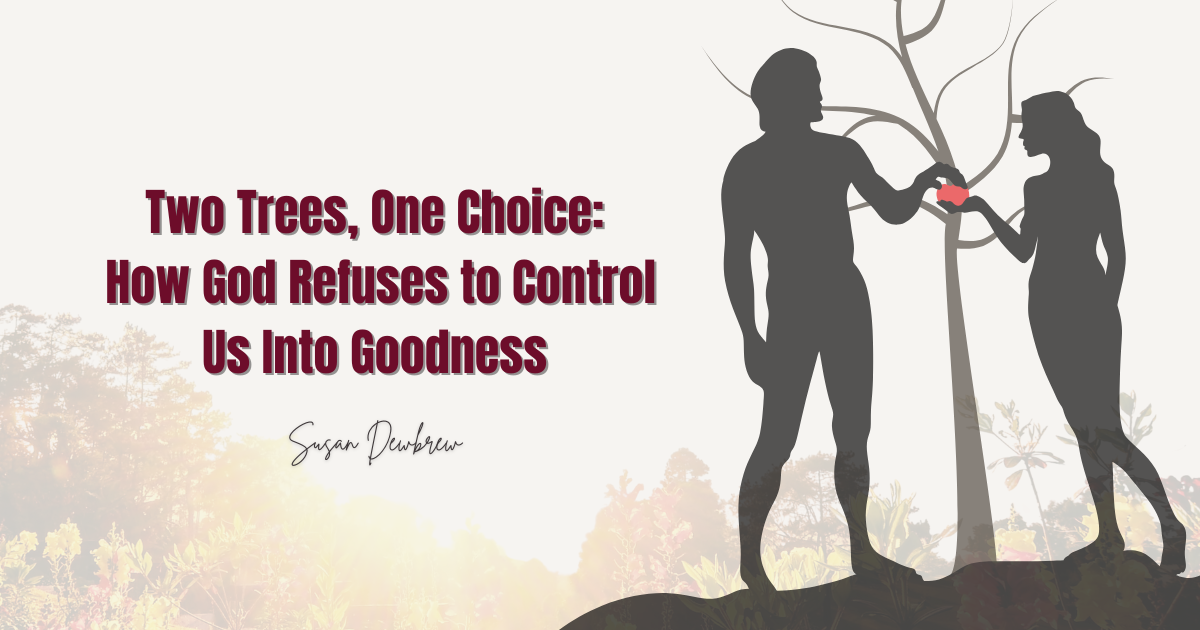
Think about it: God placed two trees in the Garden. The Tree of Life and the Tree of the Knowledge of Good and Evil. He told Adam and Eve they could eat from every tree except one. But here's what astounds me—He didn't build a fence around the forbidden tree. He didn't make it ugly or taste terrible. He didn't place armed angels to guard it.
Scripture actually says the forbidden tree was "pleasant to the eyes and desirable to make one wise" (Genesis 3:6 NKJV). God made it attractive and accessible, then trusted human beings with the choice.
Why would the all-powerful Creator of the universe do such a thing?
Because God refuses to keep us safe by imposing His will.
The Most Powerful and Least Controlling
This revelation completely shattered my understanding of God's nature. I had always thought that having power meant using it to control outcomes. If I were large and in charge, people would do things my way. How could God, with infinite power, choose not to use it to prevent evil?
But that's exactly what makes God... God.
He is simultaneously the most powerful force in the universe and the least controlling. He could force every human being to love Him, obey Him, and treat each other with perfect justice. But He won't, because forced compliance isn't love—it's coercion.
Love requires choice. And choice requires the genuine possibility of choosing wrongly.
How Love Actually Transforms the World
When the Holy Spirit spoke to me and said, "The hearts of men are now ready to receive the truth," He was revealing God's strategy for transformation. It's not revolution from the outside—it's renaissance from the inside.
God doesn't change the world by overpowering evil systems. He changes the world by transforming hearts that then change systems from within.
This is why Jesus spent three years with twelve disciples instead of marching on Rome. This is why Paul planted churches instead of leading political revolts. This is why the early Christians influenced their culture through love and service rather than force and coercion.
They understood something I was just learning: lasting transformation comes through love, not force.
The Kingdom's Upside-Down Strategy
When Jesus said, "My kingdom is not of this world" (John 18:36 NIV), He wasn't just talking about geography. He was describing a completely different operating system for how change happens.
The world's way: Force compliance. Use power to make people submit. Win through strength and intimidation.
The Kingdom way: Transform hearts. Use love to inspire change. Win through service and sacrifice.
This is why Jesus told His followers:
When someone forces you to carry their pack one mile, carry it two
When someone strikes you on one cheek, turn the other
When someone demands your coat, give them your shirt too
These weren't instructions for being doormats. They were revolutionary strategies for breaking the power of power itself.
When you voluntarily go the extra mile, you've taken control away from the person trying to control you. You've made it a "get to" instead of a "have to." You've transformed from victim to victor by choosing love over retaliation.
Why the Cross Changes Everything
The ultimate expression of this strategy was the cross. When religious and political leaders crucified Jesus, they thought they were displaying their power. They thought they were eliminating a threat to their authority.
Instead, they were breaking their own power apart like a ship upon the rocks.
Jesus willingly submitted to their violence, which completely subverted their control. They could kill His body, but they couldn't kill His love. They could silence His voice, but they couldn't stop His message. They could bury Him in a tomb, but they couldn't keep Him there.
The resurrection proved that love is more powerful than death, that service is more powerful than domination, that voluntary submission is more powerful than forced compliance.
The Pattern Throughout History
This same pattern has played out throughout history whenever lasting social change has occurred:
Jesus and the early church transformed the Roman Empire not through political revolution but through love, service, and voluntary sacrifice.
The abolition of slavery was driven largely by Christians who were convinced that the Gospel demanded the end of human bondage.
The civil rights movement succeeded through non-violent resistance that revealed the ugliness of oppression while maintaining moral authority.
Women's equality has advanced most sustainably when hearts were changed, not just laws.
When change is forced from the outside, it often creates backlash and resentment. When change flows from transformed hearts, it's embraced and sustained.
Why God Waits
This understanding helped me make peace with God's apparent "slowness" in addressing injustice. He's not slow—He's strategic. He's not indifferent—He's loving in ways that are deeper than my initial understanding.
God waits because He knows that forced compliance creates slaves, while transformed hearts create sons and daughters.
He waits because He knows that external pressure often hardens hearts, while love softens them.
He waits because He knows that lasting change must come from the inside out, not the outside in.
The Danger of Playing God
My initial response—"If I were God, I would have fixed this"—revealed something troubling about my own heart. I was essentially saying that I would use force to get my way, even if it was for good reasons.
But this is exactly the mindset that creates the oppressive systems I was angry about in the first place!
When we believe that force is an acceptable way to create good outcomes, we inevitably become what we oppose. We may have better intentions than those we're fighting against, but we're using the same methods.
This is why Jesus warned His disciples when they wanted to call down fire on their enemies: "You do not know what manner of spirit you are of" (Luke 9:55 NKJV).
Trusting Love's Timeline
So what does this mean for those of us who long to see justice in our world?
It means we choose love over force, even when love seems slower.
It means we trust God's strategy of heart transformation, even when political or legal solutions seem more efficient.
It means we model the change we want to see rather than demanding that others change.
It means we plant seeds of Kingdom truth and trust God for the harvest, even when we can't control the timing.
In my own marriage with Gregory, I've seen this principle at work. He supports my ministry to women even though it challenges traditional male authority. Why? Not because I forced him to, but because love transformed his heart over time.
He's not threatened by my success because he's secure in God's love. He doesn't need to control me because he trusts God to work through both of us.
This is what happens when hearts are ready—transformation flows naturally from love rather than being imposed through force.
The Choice Is Still Ours
God's refusal to force His will doesn't mean He's passive. He's actively working to influence, inspire, and transform hearts. He's constantly inviting us to choose love over fear, service over control, humility over pride.
But the choice remains ours.
Every day, we stand in our own Garden of Eden with two trees before us. We can choose the Tree of Life—trusting God's way of love and transformation. Or we can choose the Tree of Knowledge of Good and Evil—deciding for ourselves how to fix the world's problems.
The hearts of men are ready because God has been patiently working to prepare them. Not through force, but through love. Not through coercion, but through invitation.
And that same invitation extends to each of us: Will we trust His way of transformation, or will we insist on our own?
The choice, as it was in the beginning, is ours.
In what areas of your life have you been tempted to "play God" by trying to force good outcomes? How might trusting God's strategy of heart transformation change your approach?
Blessings,
Susan 😊