
When Power Corrupts: Why Structure Matters More Than We Think
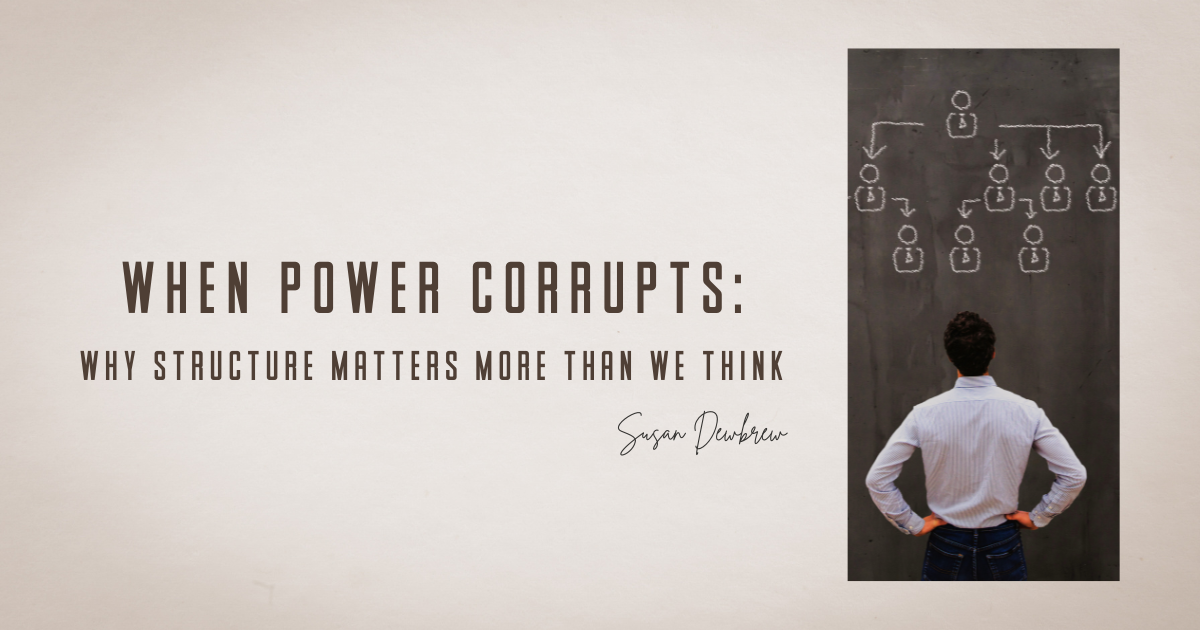
I've been thinking a lot lately about power and how it corrupts. Not just individual people, but entire systems. And I've come to a sobering conclusion: the structure itself matters more than we think.
It's not just that power corrupts individual people (though it does). It's that certain structures actually attract the wrong kinds of people to power in the first place. And the pyramid-style hierarchies that dominate much of the Christian world are among the worst offenders.
The Corruption Magnet
Here's what I've observed over decades of ministry and business: pyramid power structures tend to attract people who are hungry for control, recognition, and authority. They create environments where the most power-hungry individuals rise to the top, while those with genuine servant hearts often get pushed aside or burned out.
Think about it: if you create a system where being "in charge" is the ultimate goal, where having authority over others is seen as success, where your value is measured by how many people serve you rather than how many people you serve—what kind of people do you think that system will attract?
Unfortunately, it's often the people who want to tell everyone what to do. And those are exactly the people you don't want telling everyone what to do.
The Pattern I've Seen
I've studied what I call the "generals of the faith"—people who had amazing, miraculous ministries that were clearly God-given. What broke my heart was discovering that most of them didn't end well. And the common thread wasn't that they started out corrupt. It was that once they began to demonstrate power, even God-given power, the structure itself corrupted them.
Power without love always corrupts. Always.
The pyramid structure creates an environment where leaders begin to expect service rather than giving it. Where they start believing they deserve special treatment because of their position. Where they gradually lose touch with the very people they're supposed to be serving.
The Jesus Alternative
But here's what amazes me: Jesus was more powerful than any of these leaders. He could stop storms, raise the dead, feed thousands with a few loaves and fishes. We're talking about serious power—the power to literally reshape reality.
Yet Jesus was never corrupted. Never. Why?
Because His power was rooted in love, not in position. His authority came from His character, not from His title. His leadership was expressed through service, not through being served.
Jesus said, "You know that the rulers of the Gentiles lord it over them, and their great men exercise authority over them. It is not this way among you, but whoever wishes to become great among you shall be your servant, and whoever wishes to be first among you shall be your slave; just as the Son of Man did not come to be served, but to serve, and to give His life a ransom for many" (Matthew 20:25-28, NASB).
The Structure That Prevents Corruption
What I've learned is that the structure Jesus established—mutual submission, servant leadership, shared authority—actually prevents corruption rather than enabling it.
When everyone is called to submit to everyone else, when leadership is defined as lifting others up rather than climbing over them, when authority is measured by service rather than by control—the wrong kinds of people aren't attracted to leadership positions.
In my real estate business, I've tried to model this. I don't rule over my agents like a dictator. I don't demand special treatment because I'm the broker. Instead, I try to create an environment where everyone's gifts are valued, where expertise is honored regardless of title, where we all serve each other.
And you know what? It works. It creates a culture where people want to excel because they feel valued, not because they're afraid of punishment. It produces better results because everyone is contributing their best rather than just following orders.
The Attraction Problem
The traditional complementarian teaching on marriage and church leadership has a similar problem. It creates structures that attract men who want to control their families and women who want to avoid responsibility. It draws people who are looking for shortcuts to significance rather than those who are willing to do the hard work of love.
I've seen this pattern repeatedly: the loudest proponents of "male headship" are often men who very much want to control their families. They become pulpit-pounding advocates for submission because it serves their desire for power, not because it serves God's design for relationships.
Meanwhile, women who have been taught that their spiritual maturity is measured by how much they defer to male authority often become enablers of this unhealthy dynamic, believing they're being godly when they're actually participating in a system that grieves God's heart.
The Fruit Test
Jesus said, "By their fruits you will know them" (Matthew 7:16, NASB). So what kind of fruit do these different structures produce?
Pyramid structures consistently produce:
Spiritual abuse and manipulation
Burnout among servant-hearted people
Attraction of power-hungry individuals to leadership
Suppression of gifts and callings
Division and competition rather than unity
Families and churches that operate in fear rather than love
But structures based on mutual submission and servant leadership produce:
Empowerment and releasing of gifts
Healthy, sustainable leadership
Attraction of servant-hearted people to influence
Unity and cooperation
Environments where everyone can flourish
Families and churches that operate in love rather than fear
The Stoicheia Spirit
Paul warned about what he called stoicheia—the elemental spirits or principles of the world that masquerade as spiritual wisdom but actually lead people away from Christ (Colossians 2:8, 20).
I believe these pyramid power structures are exactly what Paul was warning about. They look spiritual. They quote Scripture. They claim to be biblical. But they operate according to the world's principles rather than God's Kingdom principles.
They disconnect people from Christ, the true Head, and connect them instead to human systems and formulas. They replace the life-giving relationship with Christ with dead religious rules about who's in charge and who has to obey.
The Better Way
But there's a better way. God's Kingdom operates on entirely different principles:
Power is expressed through service, not control
Authority comes from character, not position
Leadership means lifting others up, not climbing over them
Greatness is measured by how much you give, not how much you get
Success means everyone wins, not just those at the top
When we structure our marriages, churches, and organizations according to these principles, we create environments where the right kinds of people are attracted to leadership—people who genuinely want to serve, who are secure enough in their identity to empower others, who understand that true power comes from love, not force.
The Invitation
So here's the question: What kind of structures are you participating in or creating? Are they attracting servant-hearted people to influence, or are they drawing those who are hungry for power and control?
Are you building pyramids that elevate some at the expense of others? Or are you creating communities where everyone can flourish and contribute their gifts?
The structure matters. The system matters. And if we want to see God's Kingdom come on earth as it is in heaven, we need to make sure our structures reflect His heart, not the world's patterns.
Because power doesn't have to corrupt. When it's rooted in love, exercised through service, and structured around mutual submission, power becomes a beautiful force for good—just like it was in Jesus.
That's the alternative. That's the invitation. That's the way God's Kingdom is supposed to work.
The question is: are we ready to build it?
Blessings,
Susan 😊